Greenville Gaffer Gambles, Loses

If you’ve paid attention to soccer in the United States, it’s virtually guaranteed that you’ve heard the name John Harkes tossed around at some point.  His many notable achievements include: first American to play in the English Premier League, won two MLS Cups with D.C. United, and was a routine inclusion to the US Men’s National Team, even captaining the squad for a time.  Since hanging up his cleats [editors note: and mercifully leaving ESPN], Harkes has landed various leadership roles with clubs like D.C. United, New York Red Bulls, FC Cincinnati, and now Greenville Triumph.  There’s no doubt that he belongs in the US Soccer Hall of Fame, but even holding that status can’t protect him from criticism directed at him after the USL League One Championship.

The Greenville Triumph has managed to play in the USL League One Championship every year since the inaugural year in 2019.  In each of those championships, John Harkes was the man tapped to lead the team to victory.  Of the two championships that actually played to a full conclusion, Harkes and co. lost both.  While I can’t speak to what happened in 2019, the more I watched of the 2021 USL League One Championship, the more questions I had.  Join me below as I dive deep into some of the formations and tactics utilized by Greenville Triumph this season.  Before we do, let’s make one clear: the Greenville players deserve to be applauded, as they stuck to the game plan that Harkes planned for the championship.  It would be too reductive to say that the players lost the match.  Sure, the players had their fair share of mistakes, but all in all, John Harkes put forth a game plan that was destined to fail and did little in the way of in-game adjustments to attempt righting the ship.

Let’s start with the first issue of John Harkes’s game plan: the formation.  He chose to start the match in a 4-2-3-1.  If that number sequence doesn’t make sense, it means there were four defenders, two defensive midfielders, three attacking midfielders, and a lone striker up top.
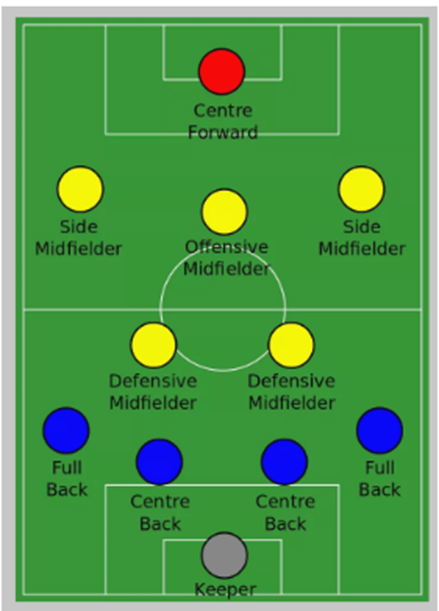
This is a formation that has been used for a few decades, but really started to experience success when it was utilized by the Spanish Men’s National Team, German Men’s National Team, Arsenal in the Premier League, Barcelona and Real Madrid in La Liga, and Bayern Munich in the Bundesliga.  Some of the benefits of the formation, heralded by soccer tacticians, include:

  • Symmetry up and down the field, allowing almost continuous pressure all over the field.
  • Additional attacking options when on offense, especially with the advancing outside backs.
  • Plenty of passing options since the formation is full of passing triangles all over the field.
  • Ability to pressure the opposition high, absorb attacks early.
  • Create a man-up advantage in the middle of the field, flushing opposing attacks to the outside.
  • Easier to repel passes and crosses into the middle of the field.
  • Easier to maintain possession because of all of the options available.

These are some of the effects of a well-oiled 4-2-3-1, but what we saw from Greenville was not a strict and disciplined formation.  As the championship progressed, I started to see how players were pulled out of position and leaving their assignments.  The formation started as a 4-2-3-1 on defense, but morphed into a 3-2-4-1 on offense.  If you’re familiar with the tactics associated with the formation, you might be thinking this is due to the “double pivot” feature of the formation, which allows one of the defensive midfielders to push forward and help with attacks, but the remaining defensive midfielder continued to position himself on the side he originally lined up in and didn’t shift to occupy the middle of the field.  This created an off-balanced defense because one of the center backs would have to occupy that forward space, instead of minding the sides of the field, which is more commonly associated with the center backs as the defensive midfielder shifts to the center.

Another aspect of Greenville’s 4-2-3-1 that was a bit confusing related to their spacing.  Teams lining up in a 4-2-3-1 often look to keep their spacing compact.  By overloading the middle of the field with players, the opposition is forced to divert their attack to the outside, which plays right into the defensive shift of the formation and gives them the greatest chance of closing off attack routes.  Greenville didn’t do this.  The backline didn’t push up the field quickly on offense, the defensive midfielders didn’t shift properly or at the right time, the attacking midfielders played back too far and left Marios Lomis alone up top.

When the defensive midfielders tried to execute the “double pivot” feature of the formation, one of them would push up the field while the team was playing defense.  Yes, you’re pushing an extra man up the field, but giving up plenty of space behind him.  The pivot is usually executed while the team is on offense, adding an extra man to the attack, and creating further instability to the opposing defense.  The timing wasn’t executed correctly, but this will be addressed later in the piece.

The spacing issue can be applied to Greenville’s offense, as well.  Most of the possessions gained in the first half were immediately given away because they would try to send a long ball up the field.  Whether the design was to merely clear the ball away from the defensive third or to streamline the offense and immediately feed the ball to Marios Lomis, it was never clear.  Most of the attempts to find Lomis up top were unsuccessful because he had no support and had to work against the entire Union Omaha backline.  Possessions in a 4-2-3-1 can be quick and can be streamlined, but the team has to move as a unit.  All season long, Greenville opted to move up the field together, pushing numbers up the field, and finding passing windows.  This didn’t happen for the Triumph until later in the match.  Their own source of respite turned out to be their worst enemy that night.

With individual responsibilities not being executed properly, you start to see a lot of the weaknesses involved with a 4-2-3-1 formation, which include:

  • Large areas of space along the sidelines and corners open up due to attacking midfielders and advancing outside backs not tracking back to help on defense.
  • Defense becoming outnumbered by the opposition if the attacking midfielders and advancing outside backs don’t get back and support the back line.
  • The lone striker being left on an island up top because the defense shifts into a 4-5-1 setup with too much space between the midfielders and the striker.
  • Lack of options on offense if the striker doesn’t hold up the play and wait for the attacking midfielders to advance up the field to provide support.
  • Again, if the lone striker is not supported, the opposing defense isn’t stressed enough and can easily outnumber and overpower the striker.

The second issue with John Harkes’s game plan: personnel.  A 4-2-3-1 is a very risky formation to utilize if you don’t have the right players and don’t have the time to adequately train the squad for their individual responsibilities.  Judging from the performances during the championship, Harkes didn’t have the right personnel and either didn’t recognize it, had too much confidence in his players, didn’t spend enough time training the players on their expectations, or was dead-set on using the formation regardless of his roster choices.  I’m going to give Harkes the benefit of the doubt and assume the last few weeks of the season was not enough for his players to fully grasp the concept of the chosen formation.

Why did I specify the last few weeks of the season as not being enough for his players?  If you include the semifinal and championship matches, the club started their last ten matches of the season with a different formation then the previous week on five occasions.  John Harkes was already battling load management and recovery protocols with his often-injured squad, but to throw the players into different schemes five times in the last ten matches is a tough demand on the players.  With every formation change, individual responsibilities change greatly, especially when you start to employ the 4-2-3-1.

I will concede that it is entirely acceptable for a coach to adjust his formation and tactics, depending on who the club is playing next and what the roster affords the coach, but think about this: if you take into account Greenville’s entire season, John Harkes changed the formation 16 times.  Furthermore, from Week 15 to Week 18, the Triumph changed their formation every week and managed to gain two points out of a possible twelve.  With a revolving door of player availability, there simply wasn’t enough time for the players to get a full grasp of their individual responsibilities and establish chemistry with the players around them.

By Week 16 of Greenville’s season, the club had experienced injuries across 14 of their 20 players.  In the toughest run of matches for Greenville, the ten matches between Week 13 and Week 22, the club changed formation in seven of the ten matches, utilizing six entirely different formations, and only succeeded in gaining nine points.  As the team entered Week 13 in second place, they are very fortunate that they only fell to third place at the end of Week 22.  Granted, they were seven points behind Chattanooga at that point and the Red Wolves had a game in hand, as well.  Nonetheless, for a club looking for some sense of stability within their roster, they sure didn’t seem to mind throwing the gauntlet at them once they were available.

In the last ten matches of the season, once again including the semifinal and championship, the 4-2-3-1 was only utilized three times, twice in the last two weeks.  That means after the club played in a 4-2-3-1 against Chattanooga on September 11th, the team wouldn’t line up in that formation again until November 13th – 60 days later.  Even after closing out the regular season against North Carolina FC, John Harkes still planned on the team re-learning their roles in the two weeks between the end of the regular season and the semifinal match against familiar foe Chattanooga.  When it came time to plan for both Chattanooga and Union Omaha, Harkes decided to insert midfielder Noah Pilato into the center attacking midfielder (CAM) position of the 4-2-3-1.  This decision brought on the next batch of issues for Harkes and the Triumph.

There’s no denying that Noah Pilato was a valuable member of the squad during the 2020 season, but his 2021 season was drastically different.  After playing in four of the Triumph’s first six matches, Pilato suffered a back injury that would keep him out of the lineup for most of the 2021 season.  The last match he played in before routinely finding himself on the injury report was Week 10.  Pilato wouldn’t be considered a full participant in training until Week 28.  The first minutes of play given to him since Week 10 would come in Week 29, where he only played four minutes.  The very next week, Week 30, Pilato was back on the bench and didn’t see any minutes.  From his full return to training in Week 28 to the semifinal match, 4 weeks later, Pilato only played four minutes.  Here’s another wrinkle into the system: Noah Pilato had never played the CAM position this season.

Of the four matches Noah Pilato played at the beginning of the season, only one of them consisted of Greenville using the 4-2-3-1 formation.  In that singular match, Pilato started at right defensive midfielder, working alongside Aaron Walker.  Looking back at the seven times that the Triumph used the formation during the regular season, the CAM position was filled by four players.  Forward Don Smart occupied that position the most, playing four matches in the role.  Since Smart hadn’t been featured on the injury reserves since Week 14, it’s a bit puzzling to think why John Harkes would favor Pilato over Smart.

This is where I find the most fault with John Harkes and his decision-making.  Honestly, Noah Pilato wasn’t ready to play in the central attacking midfielder role.  I’m not even sure that he was ready to play a full 90 minutes in a high-pressure match like the championship.  The CAM is a vital piece of the formation, requiring someone to constantly be moving and pressing, someone who can win challenges reliably, someone who can show creativity on offense, and someone who makes sound decisions on offense.  Noah Pilato was none of those the night of the championship.  He was often pulled out of position, didn’t recover that ground, didn’t make an impact on offense, and didn’t show any real desire change the flow of the match.  This goes against everything that should happen with the CAM.  He needed to stay in the middle more, slip behind Union Omaha’s midfield line, act as the creative force on offense, act as a linking source between the defense and offense, and challenge the backline more.

The attacking midfielders in a 4-2-3-1, especially the CAM, are vital to the success of the team.  There are so many individual responsibilities placed on the CAM, which explains why some of the best players in the world play this position with their club.  While the striker may apply pressure up top, they most likely will act more like a shepherd, allowing the attacking midfielders to shift and close off any potential progress up the field.  While watching Greenville play, striker Marios Lomis was working to apply pressure, but Pilato was taking a more defensively-minded position by sitting back closer to the midline, sometimes sitting in his own half.  Defensive midfielder Aaron Walker repeatedly pushed high up with the attacking midfielders to help apply pressure, but in doing so only compromised the team’s defensive structure farther down the field.  When playing a 4-2-3-1, the team has to press high and turn that pressure into their offense.  The defense almost becomes a form of their offense.  If the team is able to force an early turnover, they can outnumber the defense, and turn a fast break into a genuine opportunity on goal.  By applying the defensive pressure of a 4-4-2 central midfielder, which is what Pilato played most as before his injury, he was dooming his team’s chances at applying the right amount of pressure immediately after losing the ball.

If you read the championship recap, you saw that I mentioned how Greenville didn’t get their first shot of the match until the 19th minute.  Leading up to that, Union Omaha had their foot on the gas and weren’t letting up.  John Harkes needed to make adjustments and simply didn’t do so.  He should’ve recognized how Union Omaha was routinely able to get around the attacking midfielders, successfully get by the outside backs, and continuously put pressure on Paul Christensen in goal.  All season long, Union Omaha lived along the sidelines and fed crosses into the box.  The Owls showed capabilities of taking players one-on-one, attacking space, and developing attacks quickly and efficiently, yet John Harkes still formulated a game plan which actually played to Union Omaha’s strengths.  After seeing the first 20 minutes of the match, at the very latest, he needed to be changing tactics from the sideline.  His club was down 0-1 in the seventh minute and his opposition showed no signs of quitting.  Harkes needed to turn to his strengths in the midfield.

Aaron Walker and Max Hemmings are both good central midfielders and belong in a 4-4-2.  They’re aggressive, assertive, confident with the ball, work well together, and have the ability to make intelligent moves on the field.  They played as well as they could in the team’s formation during the championship, but weren’t allowed to show their true potential because their role was limited in the game plan.  The duo was still impactful when needed because, frankly, Noah Pilato was often absent from gameplay throughout the entire match, forcing them out of their position.  These two players were the firefighters for their team, racing across the field to put out fires, recovering time and space given up by teammates, and doing their best to absorb the attack.  This led them, and many other defenders, to be caught over-committing and biting the simple bait from Union Omaha players.

Even in the second half, Greenville showed only a few adjustments.  Their offense was still predictable more often than not.  Their wingers, the outside attacking midfielders, would run straight-line routes up and down the field while on offense.  While the outside backs were able to advance up the field more often on offense, every single one of their routes was forced to the middle of the field.  The winger and the outside back could have shown more creativity by alternating their routes inside and making Union Omaha think a little more on defense.  The Owls sat back into a more defensive shape in the second half, which allowed Greenville to attack more, but they weren’t able to generate high-quality chances on goal because they weren’t able to transfer the offense from sideline to sideline, let alone create access points in the middle of the field.  It was a tough night for Greenville and they did the best with the game plan they were given.

It was a tough season for Greenville.  The played a lot of matches in a condensed amount of time at various points of the regular season, dealt with way too many injuries, and yet still found it in their fighting spirit to make the epic comeback at the tail-end of the season.  Teams that are able to do this find a way to achieve greatness. While the Triumph didn’t win the championship, what this team was able to accomplish was incredible, considering the seemingly insurmountable odds stacked against them.  The players deserve full credit for battling to the very end.  The game plan for the championship didn’t do them justice.  I’m sure the Triumph will be at, or near, the top of the league again next season.  If they’re that good when they’re injured, everyone in the league needs to watch out for them when they’re completely healthy.

As for the fans of the Triumph, they deserve a lot of credit for sticking with their club through thick and thin.  There were plenty of tough times this season, but they hung in there and continued showing up for their club.  Maybe next season the club will break away from their role as Sisyphus – accomplishing greatness by pushing the boulder up the hill during the regular season, only to see it roll back down the hill during the championship.  The fans deserve to see their club win the trophy outright.

2021 League One Champions!

It still seems surreal: Union Omaha won the 2021 USL League One Championship.  Even after 16 days of being able to process everything that happened that wondrous Saturday, new memories still find their way to the surface.  New memories equal new smiles and another surge of pride for Union Omaha.  The players and coaching staff left no doubt as to who deserved to lift the USL League One trophy, as well as the Big Green Belt.  Before we start to report on player contracts, possible coaching changes, and what to expect from the club in the coming season, let’s take another look back at the Championship match between Union Omaha and Greenville Triumph.

Union Omaha showed zero changes to their team formation and personnel.  The team kept their 4-4-2 shape and opted to start the same lineup as they did against FC Tucson in the semifinal a week prior. [Editor’s note: probably a smart choice.] Greenville decided to keep the same shape from their semifinal match against Chattanooga (4-2-3-1), but was forced to make a lone change to their starting eleven as a result of Lachlan McLean suffering an injury.  Prior to the Championship, the Australian striker made 15 appearances, with 10 of those being a starter.  In lieu of McLean’s injury, Greenville’s manager, John Harkes, brought on Jesús Ibarra to start as the right attacking midfielder.  Ibarra would be given the daunting task of battling Union Omaha’s left side of the field, comprised of high-quality players like forward Greg Hurst, midfielders JP Scearce, Conor Doyle, Damià Viader, and defenders Jake Crull, Daltyn Knutson, and Illal Osumanu.

In Union Omaha’s first attack, team captain and defender Ferrety Sousa received a pass from teammate Illal Osumanu inside of Union Omaha’s own half.  After dribbling past the center line, Greenville’s Aaron Walker was able to gradually apply pressure, buy time for the defense to get set up, and shut down a lane toward the center of the field.  Sousa had midfielder Devin Boyce on the right side of the field, but even he was well marked by Greenville defender Tyler Polak.  Sousa’s best option was to slow down the attack and look for an open man, which in this case involved a drop to midfielder JP Scearce.  While standing on the center line, Scearce took one touch to lob the ball up the field to forward Greg Hurst, who was standing about five yards outside of Greenville’s penalty area.  As soon as Hurst controlled the ball, he was double-teamed by Greenville players Evan Lee and Tyler Polak, who left Devin Boyce alone on the side of the field to apply the added pressure.  Hurst was able to split the defenders, cut his way toward the center of the field, deke Max Hemmings easily, and open up a window from which he took a shot on goal.  Greenville’s goalkeeper, Paul Christensen, did a good job of filling the window and limiting Hurst’s angles on the goal.  Despite the fact that Hurst was able to send in a low, powerful shot on goal, Christensen was able to position himself for the easy save.

With Union Omaha’s early pressure on Greenville’s goal, the Triumph seemed to be in desperation mode on defense.  With every possession gained, they often worked too hard and too fast to move the ball up the field to forward Marios Lomis.  With all of the numbers coming back on defense, Greenville wasn’t able to provide enough support for Lomis up top and lot of their long passes resulted in a turnover and renewed offensive opportunities for the Owls.  The next video is an example of this.

Greenville’s right attacking midfielder, Jesús Ibarra, pushed up the field in an attempt to facilitate some connection between the defense and forward Marios Lomis.  When an awkward ball was played to Ibarra, an even more awkward ball was attempted toward Lomis.  Union Omaha defender Daltyn Knutson collected Ibarra’s poor passing attempt and one-touched the ball back toward Greenville’s goal line.  This was a smart move because it prevented Greenville from resetting their defense, allowed Union Omaha renewed opportunities on offense, and kept Greenville’s defense guessing as to how Union Omaha would generate their next attack. 

Knutson’s pass toward the goal line created a physical exchange between Greenville’s Abdi Mohamed and Union Omaha’s Evan Conway.  Mohamed did a good job of shielding the ball, but not good enough, as Conway was able to slip around Mohamed’s right hip, swing his left foot at the ball, and keep it inbounds.  While Mohamed and Conway were left rolling on the field beyond the goal line, Damià Viader took advantage of the given time and freedom to collect the ball. 

No defender applied any pressure to Viader until he dribbled the ball into Greenville’s penalty area.  At that point, Brandon Fricke attempted to cushion his advancements.  Devin Boyce was open near the top of the penalty area, but that opportunity passed quickly because Max Hemmings shifted to the left at the same time as Aaron Walker arriving into his own box for additional defensive support.  Seeing that Boyce was no longer a viable option, Viader made a couple of moves at Fricke, finishing off with a nice cut toward the goal line. 

Fricke set his hips to try to usher Viader away from the goal line, but gave too much space to Viader, who worked against Fricke’s hips and left him scrambling to recover.  There were too many white jerseys filling the goal area, so Viader’s best option was to take a shot on goal. 

From just about six yards away from the goal, Viader’s shot glanced off the crossbar and out of bounds for a Greenville goal kick.  Within the first six minutes of the match, Union Omaha had already generated two high-threatening chances on goal, while Greenville had barely even stepped into Union Omaha’s half.  If Greenville was going to make any defensive adjustments, this was the time to do it.  They didn’t and they were punished for it a minute later.

In the seventh minute, Greenville defender Abdi Mohamed picked up a loose ball after Greg Hurst couldn’t control it.  Almost instantaneously, Union Omaha midfielder Conor Doyle was there to challenge Mohamed a force a turnover.  Doyle’s next touch was a leading pass to Damià Viader on the outside. 

In another matchup with Brandon Fricke, Viader was able to shake him off, only this time he relied on his explosive speed.  Fricke tried a slide tackle in an effort to take away any ground passes into the penalty area.  Unfortunately for Fricke, Viader was able to lift his lob over Fricke’s leg, get it the back post, and give Evan Conway an easy header to open the score line. 

If you look closely at the video, before Viader gets his cross off, there were six Greenville players on Viader’s side of the penalty spot.  Also, as you follow Greg Hurst making his run, you can actually see him watching Devin Boyce make his decision to run toward the front edge of the goal area.  Seeing Boyce’s run and how defenders were shifting to pick him up, Hurst decided to run to the middle of the goal area, with a last-second angle toward the front goal post. 

Even Hurst’s presence in the goal area alerts the defense and continues to shift them away from the back post, where Conway showed incredible discipline to stay where he was.  Paul Christensen may have been able to turn and have a chance at diving toward the ball, but his own defender, Tyler Polak, was standing in his path, leaving him unable to make an aerial dive toward the back post.  It wouldn’t have mattered: the buildup was too quick and Conway placed the header such that a save was out of the question.

Conceding goals had been a rare event for Greenville.  Prior to the Championship, the last time a team had managed to score a goal on Greenville was all of the way back on September 25th – a road match against Forward Madison.  I won’t give you the homework to figure out how many minutes that amounted for Greenville.  The answer?  646 minutes.  That means a perfect October and six straight clean sheets leading up to the Championship.  Greenville deserves the credit for maintaining that level of defensive effort toward the end of the season and setting themselves up for success in the playoffs.  That being said, this wasn’t the same Greenville Triumph that we’ve all grown accustomed to seeing on a weekly basis.

Inside of 15 minutes, Greenville’s players were still panicking on defense.  When any of the players were able to get a foot on the ball, there was virtually no organization or buildup to their offense.  The players were immediately sending the ball up the field in lame attempts to connect with Marios Lomis.  Because Union Omaha was able to keep their defensive shape, they were able to outnumber Lomis everywhere he went.  Lomis’s touches on the ball were minimal and Greenville’s greatest offensive threat was being eliminated from the match.  This opened the door for more Union Omaha attacks.

In the 15th minute, Union Omaha was maintaining a good, constant effort of applying offensive pressure straight out of their own half.  In the next video, midfielder Conor Doyle saw Devin Boyce in open space and recognized the attacking potential.  As Doyle moved the ball to Boyce, watch as Greenville is able to get numbers back behind the ball.  Their defenders are constantly turning their heads, tracking Union Omaha players, and communicating. 

Despite Greenville getting their defense set up, Union Omaha was still able advance up the field because they utilized their passing triangles along the outside and paired that tactic with some good one-touch passing.  After Sousa loses the ball, a Greenville defender executes another poor clearance from the goal line and the ball falls right to Union Omaha’s JP Scearce. 

Rather than settling the ball, Scearce made the good decision to head the ball directly back into the offensive third and keep that offensive flame roaring.  Scearce’s header fell to the feet of Hurst, who fed a lateral pass along the top of the penalty area for Evan Conway to take a shot.  Conway would’ve loved to have that shot back, but this was another case of Union Omaha being proactive and Greenville being reactionary.  The Triumph weren’t being given time to set up their defense, or to take a collective breath while the offense tried to generate something.

Greenville fans would have to wait until the 19th minute of play before seeing the first shot.  Triumph’s attacking midfielder Noah Pilato took the shot from well outside of the Union Omaha penalty area and was blocked by defender Daltyn Knutson.  Union Omaha goalkeeper Rashid Nuhu was able to pick up the rebound without any high pressure from the Triumph.  It was Greenville’s first chance on offense, but by that time, Union Omaha had already taken five shots, two of which were on target, and tallied a goal.  It was very apparent that the Greenville formation and tactics were not right if they wanted any hope of turning the tide.  This article will provide a general rundown of the Championship footage, but discussion regarding the formation and tactics will come shortly after this article is posted.

The 22nd minute saw Greenville apply more pressure on offense, but similar to the first attempt, the shot wasn’t on target, either.  A huge reason for Greenville lacking on the offensive side was their failure to include striker Marios Lomis.  In the first 25 minutes of the match, Lomis had only touched the ball three times.  Almost half of Greenville’s goals came from the feet of Lomis and to have him looking rather pedestrian early in the Championship did not bode well for the reigning champions.

If you go back and watch a lot of footage from Union Omaha matches, it’s easy to gain more and more of an appreciation for midfielder Conor Doyle and his very intelligent level of play.  Here’s an example of that:

In the 30th minute, Conor Doyle (originally lined up as the left center midfielder) is sitting in the middle of the field, while his partner in the middle of the midfield, JP Scearce, is actually stacked above him.  Greenville’s Noah Pilato floats back to mark up on Scearce and take away the passing option.  When defender Jacob Crull looks to split Pilato and Marios Lomis, there’s too much space between the two Triumph players and they’re unable to intercept the pass.  The ball finds its way to Conor Doyle’s feet and he dribbles the ball toward the center line.  As he does so, Ferrety Sousa remains open on the sideline and is rewarded with the pass. 

The key thing to watch here is how Doyle doesn’t give up on the play.  In fact, he runs through traffic, allowing Sousa to give him an easy pass on the go, and Doyle can then push the ball inside to Devin Boyce before Allen Gavilanes can stab the ball away.  In the blink of an eye, three Greenville players are now scrambling to get back on defense and the corner is wide open.  A simple thru-ball from Boyce to Hurst extends the pressure and gives Doyle extra time to get himself into the corner.  Once Hurst relays the ball to Doyle on the outside, Hurst cuts back into the box and brings the defender with him.  Doyle tries to cross a ball to the center of the box, but Evan Conway was outnumbered by Greenville players and the ball was cleared.  The Triumph were seen over-committing on too many occasions in the first half and Union Omaha was able to generate these kinds of attacks on a seemingly routine basis.

As the second half wore on, especially around the 29th minute, you could start to see confidence building in the Greenville players.  They weren’t unleashing clearances left and right and they weren’t forcing everything up the right side of the field, which combined to allow them more time with the ball and confidence in building up their attacks.

In one of Union Omaha’s true defensive moments, you can see Greenville move up the left side of the field and genuinely start to build an attack.  A good reason for this is left back Tyler Polak moving up the field.  For the first half hour of play, Polak would sit back defiantly and avoid any notion of supporting the offense in transition.  With Polak advancing into Union Omaha’s defensive third, Greenville could begin to move the ball and stretch the space.  Unfortunately for Greenville, as a part of their tactics and formation, the ball was eventually played back toward the middle, where no one was playing at that time.

On the other side of the field, it was business as usual for Union Omaha.  Evan Conway ran into a brick wall in the 42nd minute, but was able to turn himself around and hold up play while more teammates entered the Greenville half.  One of those teammates was Conor Doyle, again gravitating toward the right sideline.  Here’s another example of heads-up play from Doyle:

After receiving the pass from Conway, you can see Doyle lifting his head up and scanning the field.  Once he plays the simple pass to Ferrety Sousa, he decides to sit back.  Why?  Because a little farther up the field is Devin Boyce, who was able to sneak behind two defenders and has space available near the corner flag.  When Sousa decided to pass the ball back to Doyle, he already knew where he wanted to place the ball.  He lobs the ball over the line of defenders, drops it right along the sideline, and Boyce is able to run it down with time to spare. 

After taking a touch, Boyce sends a cross directly into the box to Evan Conway.  It didn’t matter that Greenville had two players near Conway, he was still able to get a head on the ball.  Unfortunately, he couldn’t get the contact he wanted and sent the ball wide.  This was another good build up, good threat on goal, and the Owls were able to remain unpredictable on offense.

Greenville’s defense was constantly bending to Union Omaha’s attacks, so it was only a matter of time before they would break.  That moment would come in the 43rd minute.  Greenville defender Tyler Polak received a return pass from midfielder Max Hemmings and looked to try a one-touch drop pass.  When Polak swung his foot down to kick the ball, he catches a lot more of the turf than the ball and doesn’t generate enough force behind the ball the complete the pass. 

Fortunately for Union Omaha, Greg Hurst was right there to pounce on the loose ball and generate a fast break.  With Triumph players spread out as far as they were, Hurst was gifted plenty of room in the middle.  Defenders were trying to shepherd Hurst toward the sideline, but Hurst was able to find Damià Viader, who cut the ball back toward the middle of the field.  Viader was able to take on Abdi Mohamed and dribbled toward the penalty arc. 

As he came across the box, Tyler Polak was positioned too far toward the middle of the field and Devin Boyce was left wide open on the right side.  While Polak was struggling to close in on the ball, all Boyce had to do was a simple cutback, let Polak’s momentum carry him out of the play, and Boyce suddenly had space inside the penalty area again. 

When Boyce took his shot, he wasn’t able to execute the shot he wanted, but Hurst was there to redeem him for the highlight reel.  In what looked like a bad shot toward the goal, the ball ended up at the feet of Hurst, who stuck a foot out and redirected the ball into the back of the net.  An ugly shot turned into an assist and Union Omaha managed to double their lead right before halftime.

The first-half stats tell the whole story:

Union Omaha had the lead, more shots, more shots on target, didn’t need to rely on possession, and still remained pretty consistent with their passing accuracy in either half of the field.  Greenville, however, didn’t seem to pose a threat in the first half.  Their long passes come from trying to move the ball out of their defensive third as quickly as possible, but once they were finally able to carry the ball across the center line, their offense sputtered.  They didn’t have a quality link or transition from defense to offense and they crumbled as soon as they crossed into their opponents half of the field.

As the second half started, Greenville chose not to make any personnel changes and decided to keep their 4-2-3-1 formation.  There were two other noticeable changes with Greenville: their players were spreading out even more when in possession and their outside backs looked very willing and determined to make their way up the field.  The players were moving the ball with a lot more confidence and worked hard to open up the left side of the field.  In the first half, most of Greenville’s offense was generated on the right side, but they were still able to produce some good possession on the left side just before half, as well. 

The Championship match started to become a chippy affair, especially after Evan Conway’s foul against goalkeeper Paul Christensen in the 50th minute.  This wasn’t mentioned earlier, but Conway did receive a yellow card in the first half.  When Conway was able to split a pair of Greenville defenders, he continued dribbling toward the goal.  Max Hemmings was able to wedge himself between Conway and the ball, allowing Christensen to come off his line and get his hands on the ball.  Conway, attempting to challenge Christensen, stuck his foot out for the ball just after Christensen had already collecting the ball. 

Yes, it was a nearly instantaneous exchange, but you have to remember: Conway is sitting on a yellow card.  Union Omaha may be up 2-0 in the 50th minute, but is challenging that ball really worth the risk of getting a second yellow card, finishing the match in the locker room, and creating a nearly second half-long disadvantage for your teammates?  I don’t think so.  With as much as referees protect goalkeepers, and deservedly so, Conway should not have given the referee any opportunities to award him a second card.  Ultimately, the referee made the difficult, yet right, decision to give Conway a stern warning and continue play.

Only two minutes later, Conor Doyle was approaching Aaron Walker to apologize for a challenge and Abdi Mohamed showed exception to Doyle’s challenge and exchanged pleasantries.  This became a recurring theme as the match drew closer to the end: Greenville would feel the need to file their grievances with lengthy conversations, yet seemed to not care at all about the clock and their dwindling opportunities to even the score. 

Yes, Greenville may have been operating on the basis of influencing the center referee into awarding cards and fouls in their favor, while also trusting the fourth official to maintain accurate notes for extra time at the end of regulation, but why let the result rest in the hands of people other than your teammates?  Get the ball back in play, move it with a sense of purpose, and generate some offense.  Long story, short: they didn’t.

Here’s a moment where Greenville continued to show more confidence with the ball and even maintained possession outside of Union Omaha’s penalty area.  As you watch the following video, look at how condensed the midfield and defensive lines are kept.  The Owls do a good job of shifting and adjusting their responsibilities.  Case in point: Damià Viader was a winger, yet was playing in the middle.  Conor Doyle, who was one of the central midfielders, shifted to the outside.  As the throw-in happens, Doyle is set on the right side of the field, yet finished the play on the left side of the field.  Even Evan Conway was able to apply some pressure.

Since Doyle started on the right side, Viader floated in, but as the ball continued to move from Greenville player to Greenville player, Scearce drifted up to apply pressure, then Viader did the same on the next player.  This movement allowed Doyle time to scan the field, recognize where the players were set, where the ball was likely to go, and get himself into a good position to continue providing valuable defensive coverage.

While the play ended with Union Omaha conceding a foul, the Owls continued to commit small, nagging fouls which disrupted Greenville’s rhythm, possibly taking their focus off of the match as a whole, directing their focus toward the next physical encounter with the rival Union Omaha player, and managed to eat up the clock.  Every time the ref blew the whistle, he had to justify himself to the players, take time to mark off ten yards, and spray the field in both locations.  It simply ate up the clock.  This is just another facet of the gamesmanship involved in soccer, especially toward the end of the match.

Union Omaha fans thought the Owls had tripled the lead in the 70th minute, but the referee disallowed the goal and restarted play correctly.  Union Omaha earned a corner kick and Devin Boyce kicked an out-swinger, which was cleared away by Max Hemmings and Jesús Ibarra, but Damià Viader was able to lob the ball right back into the action, helped further along by a header from Daltyn Knutson.  When Brandon Fricke fails horribly at clearing the ball, Hurst moves in to challenge Paul Christensen on the goal line. 

Before Hurst leaves the ground, he doesn’t quite get his feet set in place to make his jump straight up and down.  He’s perfectly in the right to challenge the keeper, but because he drifted to his right and into the keeper, it was an easy call for the center referee.  It’s not uncommon for keepers to try to give themselves space during an aerial challenge and protect themselves by leading their jump with a knee in the air, but Christensen must have felt threatened enough by Hurst’s challenge to feel the need to jump with two legs, instead of one.

 The yellow card that Evan Conway earned in the first half would finally come into play, but not until the 77th minute.  After the stern warning doled out earlier in the second half, Conway continued to press the issue.  The center referee finally had enough.  When Max Hemmings was dribbling the ball into the Union Omaha half, Conway was hot on his trail and gave the slightest of pushes from behind, sending Hemmings to the ground. 

Sure, it was a silly challenge to award a yellow card, but it wasn’t an isolated incident.  The referee awarded the second yellow card for persistent infringement and Conway was given an early exit from the match.  It was an unnecessary foul, especially with so many teammates already behind the ball.  Conway could have easily continued to shepherd players to the outside and reduced his defensive stance, but that didn’t happen.  [Editor’s note: but don’t you love the pressing/defensive energy he was bringing to the game?!]

Thankfully, the red card was awarded in the 77th minute, instead of the 50th.  Earning a red card, even if it was late in the second half, still put his teammates in a difficult position.  Fortunately for Union Omaha, Greenville was doing well with possessing the ball in the Union Omaha’s half, but couldn’t figure out a way to make Rashid Nuhu nervous.

After the Evan Conway red card, and a couple of Greenville substitutions, the Triumph started to show some quality up-tempo movement from the midfield and striker, but still not enough impetus from the defensive line.  When Alex Morrell and Nico Brown were subbed into the match, they did a very good job of injecting energy into the offense.  In fact, within two minutes of being subbed on in the 82nd minute, they almost combined for a goal.  All in all, Greenville was still guilty of being too willing to drop the ball, possess, and slowly build up their attack.  It really didn’t make too much sense, but maybe the Greenville players had already conceded victory, despite having a man-up advantage for over 20 minutes of play (with extra time included).

Another moment of controversy occurred late in the match, when Greenville was given a corner kick in the first minute of extra time.  The service was perfectly placed at the top of the goal area and Andrew Booth was able to get his head on the ball and direct it at the goal.  Rashid Nuhu was able to catch the ball and immediately went to ground.  While he was on the ground, the ball seemed to be uncontrolled for a quick second and Greenville players and fans have every right to contest the no-call. 

Since USL League One doesn’t employ Video Assistant Referee, the problem lies with where the referees are positioned at the time in question.  The center referee looked to be outside of the penalty area, toward the left side of the middle of the field, and had no way of seeing the ball over the line, let alone rushing into the box in time to see the placement.  Meanwhile, the assistant ref, placed on the opposite sideline of where the corner kick was taken, had the best chance at making the call.  She was obstructed by the goal post, as well as Toby Otieno’s leg.  If she couldn’t make the call with 100% confidence, she made the right call with not awarding a goal to Greenville.

Once the video replay showed a close-up of the situation, even from the angle of the cameras used for the broadcast, the ball looks to have moved across the goal line.  The color commentator for the broadcast, Devon Kerr, used the perfect analogy for what Rashid Nuhu was doing as he was on the ground with the ball: framing the ball much like a catcher does in baseball.  While Nuhu was on the ground, it looked like he was situating the ball such that by the time any referee could get a good look at the ball, it would be on top of the goal line at the very least.  With regards to Toby Otieno’s leg, the fact that he had his leg on the outside of the goal line gave the assistant referee even less of an angle to see.  With his leg along the outside of the goal line, that’s a few more inches obstructed from her vision and more room for error with Nuhu and the ball.  Neither referee could say with absolute certainty that the ball crossed the line, so play had to be continued.  The replay seemed to indicate otherwise, though. [Editor’s note: I’m not as sure the whole ball crossed the whole line. Maybe if they had better cameras…]

Just like the teams battling in extra time, the scoring wasn’t finished, either.  After a throw-in from Emir Alihodžić sailed over three Greenville defenders, Toby Otieno suddenly found himself in a race toward the net with Tyler Polak.  Evan Lee can be seen positioning himself at the top of the goal area, but Toby gets around a frankly terrible display of defending from Lee and buries the ball into the far-post netting.  The second goal may have been the insurance policy, but the third goal was nothing less than the dagger in the heart.  There may have been three minutes left in extra time, but all hope of a comeback was dashed with Otieno’s calm finish.

As if signifying the beginning of the happiest choir performance in Omaha, the final whistle was met with nothing but utmost joy and celebration.  There was no reverie among the players and fans because the reactions were completely instinctive.  It would take several seconds before pleasant memories would begin to form.  This may have been Union Omaha’s second year in existence and second year of eligibility for the Championship, but the wait for professional soccer in this region has been much longer.  Teams formed and those very same teams faded, only to become lore of Nebraska sports.  Among the 5,221 people that made their way to Werner Park that evening, there was a sense of relief.  Union Omaha is here to stay and with it, their greatness.

Congratulations to Union Omaha: the players, the coaching staff, the front office workers, the medical crew, the field crew, and everyone else who had a part in this momentous occasion.  A warm thank you goes out to everyone, past and present, associated with the club.  The devotion and commitment to success goes without saying, but the continued outreach and reverence toward the fans and surrounding community cannot be adequately described through words.  Not even the voices of support, the tifo, the posters, the songs, and the thunderous applause can even remotely express our sincere gratitude for what you, Union Omaha, have given to your fans.  Though the meaning of this championship translates differently from person to person, we can all agree when we say those two simple words: thank you.

¡Viva Búhos!

What it means to us…

While the goal of sports is to win a championships, sports are so much more than that. As I was driving home from the game, I really wanted to share my thoughts on what this win meant to me. In wondering how I should do that, I eventually recalled that I’m technically the editor of this website. So I asked all of the WGaH contributors to share their thoughts with me, just so I could share mine.

Luke Opperman

The win last night was the dream culmination of the amazing work of everyone from Gary, Jay, the FO, players, fans, and technical staff. The win means everything, the exhale of relief was real, so much time and effort went in to this and you could feel it in the stadium. Personally, this win meant the future of this club will continue to burn brightly and bring opportunity to so many people in the metro and beyond. The result is idyllic and I’m not too proud to say that the tears I shed upon winning were amazingly cathartic. There’s a long road ahead for this club but the support from ownership, fans, and staff are there to see Omaha become a destination for young talent on the field and fans in the stand. To all the players who won’t return, once a Búho, always a Búho.

Jon Ryan

Words can’t really describe the feeling of your local club winning a championship. The accumulation of individual moments over the course of an entire season, even the tiniest of both highs and lows, leads to feeling every possible form of emotion immediately. But after having time to absorb it all, the most dominant emotion is pride. Pride for the players, technical staff, front office staff, and all of the supporters that lived and died with this team nonstop this season.

Ryan Legrande

When it was announced that a professional soccer team would be in Omaha, I immediately dreamed of a team that I could watch win a championship. At the time I thought it would take years to build to that. There is nothing quite like watching a club you’ve poured your energy, your time, and your emotions into win a championship. The fact that they got to do that at Werner Park and in such a convincing way was icing on the cake.

Rich Flemings

Being able to witness Union Omaha winning the title isn’t just about the superficial appearance of a sports team winning a title. After being a season-ticket holder since the beginning, the team has taken on a different level of meaning to me. It’s no longer a means for me to go out and watch live soccer. When you attend home matches on a consistent basis, go to watch parties when the team is on the road, hang out with wonderful people at tailgates week in and week out, that seed of emotional connection has already been planted. You no longer root for the brand of the club. You root for the players, who you share moments with after matches, at public appearances, and off-the-book outings with fans. You root for the club because of the amazing Front Office workers who are there to answer your questions, provide assistance when you least expect it, and to joke with whenever they aren’t busy racing around the stadium. The level of fandom elevates itself to something unfamiliar to a lot of people who follow pro sports in a different metropolitan area. Union Omaha isn’t shelling out millions of dollars on players who are looking to expand their individual media empire. The players on the team are established professionals who have bright futures. Watching young players grow and develop, especially under Jay Mims and Co., leads me to believe that Union Omaha has just as bright a future as each player does individually. Union Omaha doesn’t have multiple barriers, literally and figuratively, between itself and the fans. They want to embrace the fans, they want to welcome them into Werner Park, and they want to grow roots in the area for years to come. Omaha has seen sports teams come and go, but the way that Union Omaha has run their club so far, I have no doubt this club will be around for a long time. Rooting for Union Omaha isn’t just rooting for a team or a brand. It’s rooting for a community of which I’m proud to call myself a member. #OneMeansAll

Bryan Daily

Union Omaha are Champions of USL League One. It feels great to say. After a crazy pregame of watching Liverpool beat up on my brother’s favorite team; Arsenal; sitting right next to him none the less, we then moved our attention to the real game on our minds. The one that had been there since the inception of the team three years ago.

When it was announced that Omaha was going to be getting a professional soccer team it hit me at the perfect time in my fandom. I had been watching the Premier League for a year or two, had chosen a team and was still in the process of learning all the little intricoes of the beautiful game. I felt connected to the game through the Omaha Liverpool Supporters group. Being so far away from the team itself it gave me the feeling of being there without having to be there. They were so welcoming to a newcomer, and genuinely wanted to hear about me and my journey that led me to their supporters’ group. I am a part of the group and will continue to be for as long as I am able to. 

 As someone that always only watched Nebraska athletics, I did not really have a powerful sense of pride about the city. Matter of fact, I had a strong dislike of the city itself. My father, Grandfather, and future Father-in-law all worked for the city of Elkhorn before the annexation. We did not know if any of them would have jobs if the annexation went through. And the way the city went about it left a bad taste in the mouth of everyone who lived and worked in Elkhorn. But everything worked out in the end, with my father and to be father-in-law getting jobs with the city of Omaha and my grandfather retiring finally. That and with the city putting in the work to make sure Elkhorn had the same quality of care for the roads and public works it made me take pride in the city, but I was still no fan of the athletic teams in the city. That was until Union Omaha came about. 

I remember being so excited when I heard about the team. Wanting to know more about them immediately and wanting to know how to be a supporter. I got all the emails and sent my input into the club in the naming of the club and the crest design. I bought my season ticket day one, was ready to be involved day one. I was devastated to learn that the crest unveil was taking place during a time that I could not attend. So, I fired up the livestream, when I saw the black tarp drop down, I was in awe. It was perfect, everything from the colors to the crest itself was perfect. You could see that the people involved really knew the city and how to incorporate everything into it. We were building something incredible. 

The people I’ve talked to, the events I’ve attended, the games we won, and the games we lost have given me a sense of pride in a city I did not consider my home city, even though I grew up in a suburb of the city itself. Union Omaha has changed that for me. Parliament has changed that for me. I am and will be forever grateful for this club and this supporters group. I may not always be around for the events the amazing supporters groups throw, I am a family-oriented person first, but I am always there in spirit. Thank you to everyone involved with this club. From the Owner of the club all the way down the the first time fan attending the match, I appreciate you, more than words can express. Thank you Union Omaha.

Ben Turner

When I left the game, I was focused on how satisfying this was to celebrate with my friends. How satisfying it was to hug the people that I’ve been on this journey with. After hanging out at Switch with Parliament and the team for a few hours, I realized it was more than just the relationships with my friends that meant so much.

The beauty of soccer at this level is that the players are so accessible to us as fans. If you want to, you can build a relationship with them. Riding home from the celebration it struck me just how ridiculous, amazing, and satisfying it was to have just one player, let alone multiple players, from my favorite soccer team know my name.

Speaking of conversations, I ended up talking to a player at the end of the night who thanked me for still supporting the team after everything that happened with my job last year. I sort of laughed it off and gave my standard answer: “I was never going to let anything stand between me and the pro soccer team in my hometown.” It wasn’t until the next day that I realized just how much hearing this person say that, to me, meant to me and just how badly I needed to hear that. It was like something inside me that had broken when I was laid off and has been taking its sweet time to heal had finally knit itself back together.

Besides my professional journey Winning the USL1 Cup (does it even have a name?) brought so much closure to the journey as a fan that I’ve been on since May 1st, 2019, when the team was announced. I was just one guy wishing he could watch pro soccer in his adopted hometown. But I’ve been swept along by the excitement and on the way I’ve joined in fellowship with so many people who mean so much to me now. Winning the final, doing the double, it brings an incredibly satisfying end to this phase of the journey for all of us.

I’m going to savor this for myself, but watching those I’ve come to care about deeply: the players, the fans, and the staff savor it as well makes it just that much sweeter. We can’t know what the future will hold, but what ever it does hold, these are our moments and memories to cherish and like the star above the crest, we never have to give them back.

Riley Martin

It’s Belt Cup Time!

Union Omaha vs. Greenville Triumph

Werner Park, Papillion, Nebraska

4 PM (CST), ESPN+

            Can you feel the electricity in the air?  No, I’m not talking about the electricity from all of the people hanging their Christmas lights early, or the ones taking up space in the Werner Park’s parking lot.  I’m talking about the USL League One Championship.  Today will be the deciding moment for both Union Omaha and Greenville Triumph as they take the field at Werner Park to decide who gets the belt and the USL1 Cup.

            These two clubs were at set to face each other last year in the USL League One Championship, but due to COVID concerns, the match was cancelled on October 29th, 2020 – mere days before kickoff.  Greenville was awarded the cup as a result of their superior points-per-game average.  But today, there won’t be any last-minute scramble to determine the winner based on statistics.  This year, the winner will be decided on the field.

            Union Omaha, and their fans, had to wait 177 days from the day the Championship was cancelled last season to the start of the Búhos season this year.  That’s a long time to have that nagging sense of incompleteness.  Now, 210 days later, we find ourselves with another round of the budding rivalry between Union Omaha and Greenville.

            Greenville coach and US Soccer Hall of Famer John Harkes brings his disciplined, technical, and cerebral squad to Omaha looking to confirm their belief of being the better club.  This is a team that hasn’t lost a match since August 28th.  They were one of the hottest teams as the regular season ended and they kept that momentum going into the playoffs.

            One reason for the continued success of the club has to be the backline, as well as they’re depth at goalkeeper.  With a defensive backline consisting of Tyler Polak, Brandon Fricke, Evan Lee, and Abdi Mohamed, Greenville has maintained their success, even despite midseason woes, injury spells, and lineup fluctuations.  The Triumph have only allowed six goals more than Union Omaha, but also racked up 14 clean sheets.  If the number of clean sheets doesn’t jump out to you, consider this: each club played 28 matches in the regular season.  That means Greenville was able to prevent their opponent from scoring a single goal against them in half of their matches this season.  That’s incredible and deserves recognition.

            Another reason for the sustained success is Greenville’s depth at goalkeeper.  Dallas Jaye had been the man in the net for the Triumph since 2019.  He won the 2019 and 2020 Golden Glove award, as well as the Goalkeeper of the Year after last season.  As the 2021 season rolled on, John Harkes started noticing increased competition on the training ground from backup goalkeeper Paul Christensen.  At some point this season, Harkes made the difficult decision to bench Jaye and start Christensen. [Editor’s note: was it really that hard after Jaye cut his hair?] It would have been easy for Harkes and Greenville to continue riding the coattails of Jaye for another season, but Harkes showed he is capable of making tough decisions and ones he feels are necessary for the continued success of the club.  After Jaye was able to accumulate six clean sheets, Christensen filled his shoes perfectly and continued on to earn eight clean sheets.

            I’d be remiss if I didn’t also mention Greenville’s prolific goal scorer, Marios Lomis.  So far this season, Lomis has scored 15 goals in 27 appearances – good enough for second place in the Golden Boot race.  When Greenville takes the field, they basically reserve the attacking third for him, let him loose, and watch him rack up the goals.  The next highest goal scorer on the team is midfielder Aaron Walker with five goals, followed by forward Lachlan McLean with three goals.  The strength of Lomis is also the weakness of Greenville.  With proper planning and execution, Lomis’s role on the field could be diminished and with it goes Greenville’s scoring security blanket.

            These two clubs have faced each other three times in the past two seasons and both clubs have a win, a loss, and a draw.  Each club has scored three goals in the series, as well.  The last meeting between the two came on October 9th, 2021 and Greenville returned home with a 1-0 win, thanks to an early 12th minute goal from Marios Lomis.  Not to make excuses for that match, but neither Evan Conway nor Greg Hurst started that match and Union Omaha played a very passionless first half.  As soon as the second half began, which involved both Conway and Hurst being subbed on, Union Omaha controlled the entire second half, peppering the Greenville goal with shots and creating one-way traffic in their half of the field.

            Greenville is a very patient team who loves to play out of the back.  They also love square passes and drops, seeming to choose those passing routes over pushing the ball forward.  Whenever the goalie has the ball, whether it’s a goal kick or the result of a drop pass, you’ll notice that the entire team immediately spreads out to the dimensions of the field.  They aren’t going to bomb the ball up the field and take their chances.  Instead, they’re going to stay calm, look for an open teammate, and not take a risk.  As a result, this means they take their time to build their attacks.  It’s a very calculated maneuver.  With the field dimensions inside Werner Park, they won’t be gifted that kind of time and space.  It will be interesting to see how they plan for their second overall visit to Werner Park.

            If Union Omaha players want to set themselves up for the best chance of winning today’s match, they have to keep this condensed.  Greenville is comfortable with time and space, so Union Omaha has to jump on that and make them uncomfortable for the entire match.  This “condensed” word also pertains to Union Omaha players.  They need to keep their lines close, force repeated duels, and elicit irrational decisions from Greenville players due to panicking from constant pressure.  This increased pressure will also work toward defending against Aaron Walker, who has been very successful at orchestrating the Greenville offense.  If Union Omaha can limit his influence on the flow of the match, they’ll have a greater chance of success, as well.

            On offense, Union Omaha needs to keep Evan Conway and Greg Hurst involved.  With the strong cast of supporters in the midfield, this is bound to happen.  Also, continue crossing the ball as much as they have been all season.  Paul Christensen has a lot of confidence right now and is not afraid to leave the goal line in favor of punching away crosses.  If enough bodies can fill the box and the cross can draw him out, Union Omaha is in prime position for more tap-ins.

            At the end of the day, today is about celebration.  It’s been a great season for both clubs and these two are creating a rivalry that any soccer fan would appreciate watching.  The production from both sides is at a high level, the coaches operate with high tactical intelligence, and the fans seem to have taken a liking to one another, as well.  Make no mistake, though: Union Omaha wants the Cup and the Belt and are ready for today’s match.  It’s going to be a good one, so if you aren’t at Werner Park, sit back and relax.  If you are in Werner Park, don’t ever let your pants touch your seat.  Stand up, get vocal, and make sure Union Omaha knows they have the full support of every fan in attendance.

            Today’s tailgate will be starting extra early, so head over to Werner Park for the 11 AM start.  This week features BBQ, which is bound to disappoint no one.  On the way to the stadium, get yourself even more hyped by listening to the latest episode of the “Who Gives A Hoot” podcast.  They fellas had a live episode last night, which you can find on Instagram.  If you forgot your scarf, or are in the mood to continue collecting more merchandise, there will be a booth set up with discounted prices on all of its items.  We can’t wait to see you at the stadium.  ¡Viva Búhos!

Freezing out the Desert Kings

Happy Friday, Búhos Nation!  We here at Who Gives A Hoot Media hope you’ve had a wonderful week.  It’s nice waking up every morning knowing that your local club is gearing up for the Championship.  Just as you wake up every morning to prepare for the workday, know that Union Omaha players are waking up with the same sense of purpose.  Let those good vibes continue to carry you into Werner Park as you support Union Omaha one last time in 2021.

I think we can agree on one thing: no one ever told the Owls, “Never force anything in your life.  If it’s meant to be, it will be.”  Nope.  Union Omaha took the field at Werner Park last Saturday knowing full-well they were going to force the issue and take what they deserved.  After an eventful 90 minutes, they succeeded in doing just that.  So before we turn our attention to the Championship, let’s take one more look at the semifinal against FC Tucson.

            Before the opening kickoff, there were a few interesting roster decisions made by Union Omaha coach Jay Mims.  Defender Jake Crull was chosen to start at the left back position, which is usually designated for Damiá Viader.  In lieu of that decision, Mims opted to push Viader up to left side of the midfield.  Interesting decision, but the rationale makes perfect sense: maintain stability on the backline and push Viader further up the field, allowing him to get involved in more of the action via an advanced offensive position.  Also, with as much space as FC Tucson gifts their opponents, it was really smart of Mims to let Viader take ownership of more space on the field.  He’s been a great addition to the offense, knows how to score goals, creates plenty of opportunities in the box with his crosses, has the speed to make up any lost ground, and has the awareness to float into threatening spaces.

            The other roster adjustment was moving midfielder Conor Doyle to the middle.  Because Damiá Viader moved up to the left midfielder position, Jay Mims decided to slide Doyle inside.  Again, this is an intelligent move.  By pairing Doyle up with JP Scearce in the midfield, Mims is assuring quality defense in the middle of the field, while relying on their combined passing acumen to generate quality offense on the other side of the field.  With FC Tucson lining up in a 4-3-3 (even if they didn’t maintain it), having two dependable, defensively-gifted midfielders to pressure the lone opposing midfielder in the middle of the field was the right call.  You can look at just about any offensive and defensive statistic from the regular season and you won’t have to read much before you come across both of these names.  They are most reliable with their aerial duels on defense and have a look-forward-first mentality when holding possession.  While the duo may not be your scoring options in the midfield, they don’t have to be.  With the amount of offense they generate, it’s perfectly okay for them to let scoring goals take a back seat.

            Jay Mims and his coaching staff did a masterful job of preparing for this match.  They positioned players to flourish and impressed upon the team three simple ideas that would lead to success:

  1. Cooler heads prevail.
  2. Crash the goal.
  3. Limit your touches, move the ball quickly.

            From the opening whistle, Union Omaha let it be known that there was going to be no space granted and no respect for play development afforded to FC Tucson.  Case in point: the video below.  This play happens within the first 30 seconds of the match.  After FC Tucson wasted their opening kickoff, Union Omaha goalkeeper Rashid Nuhu, in expected fashion, launched the ball up the field.  Watch as Union Omaha forward Evan Conway and FC Tucson midfielder Mohamed Kone prepare for the impending duel.  You’ll see that as those two come together, FC Tucson defender Luca Mastrantonio abandoned his defensive post to assist Kone.  As Union Omaha midfielder Devin Boyce picks up the loose ball, the damage has already been done.  FC Tucson central defender Kaelon Fox and his right back Noah Franke could have been in a man-up situation, but were suddenly facing man-to-man coverage.  FC Tucson left back Maximiliano Schenfeld had to scramble toward the middle to apply pressure on Boyce.  The play was developing too quickly for Schenfeld to be impactful, so Fox and Franke had to set a high line of defensive pressure, losing their defensive markings on Damiá Viader and Greg Hurst.  Another result of Schenfeld’s movement inside was the real estate that was suddenly available for Union Omaha midfielder JP Scearce.  Without hesitation, Scearce sprinted into space and directly toward the back post.  With a simple through ball by Boyce toward the goal line, Viader was all alone to make a low, driving pass to the back post.  Unfortunately, Scearce was just out of reach of the pass and the ball continued toward the sideline.  It very easily could have been a 1-0 scoreline inside of 30 seconds, but Búhos fans wouldn’t have to wait long to celebrate another attack.

            In the second minute of play (yes, you read that correctly), Doyle was able to collect the second ball from an aerial challenge.  Instead of looking backward to pass and settle into possession, Doyle pushed the ball up to Union Omaha right back, and team captain, Ferrety Sousa.  What you’ll see next is an example of great combination play among the three teammates.  By committing to one-touch passing, you can see how quickly the FC Tucson’s defense, namely Maxi Schenfeld, get lost in the dust.  After Boyce sent the pass into the corner, you can already see Sousa picking up his head and looking into the penalty area for an offensive opportunity.  While he’s doing that, Schenfeld has no option but to put on the afterburners to merely keep up with Sousa.  Schenfeld didn’t have the option of maintaining composure in the corner.  He needed to get there as quickly as he could.  Realizing Schenfeld had only forward momentum, Sousa performed a simple cutback to evade him again.  Since Schenfeld was caught over-committing again, FC Tucson forward Kevin Rodriguez was next in line to apply pressure.  Rodriguez was originally marking Boyce, but had to leave him and divert to Sousa, instead.  All Boyce had to do was pull up on his run into the attacking third, provide an option for a drop pass and he could suddenly drive at the goal.  After yet another quick exchange of passing between Boyce and Doyle, Boyce had a window of opportunity to take a shot on goal.  Boyce’s shot careened off the near post and was redirected to a perfectly-positioned Evan Conway ready for the easy tap in.  Let the onslaught begin.

            Those 1-2’s, sometimes called wall passes, that you’re seeing in those videos are highly effective ball-movement techniques to cut through the defense quickly, take advantage of space, and eliminate defenders from the rest of the play.  Union Omaha did a great job of planning for FC Tucson because, while they respected the speed of their defensive adjustments, the Owls utilized a great strategy to limit the time they have to move personnel, limit pressure, and capitalize on open space.

            In the 31st minute, Luca Mastrantonio tried to force the ball up the middle to Daniel Bedoya, but his pass wasn’t handled well by Bedoya.  In his defense, it’s tough to settle a slow-moving lob with two defenders, in this case Devin Boyce and JP Scearce, in hot pursuit.  It looks as though Bedoya was trying to split Boyce and Scearce with a pass to Mohamed Kone off his thigh, but couldn’t get enough power on it.  Either way, the ball was given up and Scearce was able to jump on it with a toe-touch pass to Evan Conway before Kone could make a proper attempt at a clearance.  When Conway turned, Kaelon Fox was there to usher him toward the sideline.  If Maxi Schenfeld had kept his positional discipline and remained at left back, Conway wouldn’t have anywhere to go.  Given his absence, Conway was able to carry the ball further into the attacking third.  You can see Conway thinking about cutting across Fox to get inside of him, but Kone was making up ground quickly.  Instead, Conway continued on course toward the goal line.  Greg Hurst was wide open between the goal area and the penalty spot, but there were too many defenders and the window was too small to make a viable attempt to pass to him.  As the angle on goal was getting tougher and tougher, Conway sent a low ball toward the back post.  Even goalkeeper Wallis Lapsley thought Conway was going to make attempt on the near post, so when Conway aimed for the back post, Lapsley’s momentum was carrying him away from the shot.  Conway didn’t put his laces through the ball, but countered with accuracy.  The ball gently tucked itself just inside the far post and Union Omaha’s lead doubled.

            After the goal was scored, the Union Omaha players came together to celebrate and Maxi Schenfeld became irate.  Just two minutes prior, Schenfeld earned a yellow card after a physical challenge on Devin Boyce.  Despite this knowledge, Schenfeld walked toward the celebrating players, gesturing toward them, and filing his grievances with the referee.  In his approach toward both the players and the referee, he became enmeshed with Union Omaha players, quickly resulting physical altercations.  While attempts were made to separate the players, the referee awarded Schenfeld with a straight red card.  For those that are unaware, it is possible for a player to have a yellow card and still receive a straight red card.  Two yellow cards do equal a soft red, but a single yellow card can be followed up with a hard red, if the referee deems the offence is worthy.  If you look closely and slow down the video, Schenfeld seems to punch Damiá Viader in the face.  It’s hard to see in real-time, but seeing how the referee was within an arms reach of both Union Omaha players and Schenfeld, he clearly saw the retaliation.  The red card was awarded for violent conduct, Schenfeld was sent to the locker room, and FC Tucson was forced to play down a man for the remaining 59 minutes of the match.  The replay clearly shows Boyce taunting Schenfeld after the goal, which is why Schenfeld was so upset.  As a result of Boyce’s actions, he was deservedly awarded a yellow card.

            There’s no doubt that Maxi Schenfeld had a case against Devin Boyce, but by getting himself in the thick of the Union Omaha post-goal celebration, he was baiting a physical altercation.  He could have eschewed himself away from the celebrations, raised his concerns with the referee, and come out of the incident still carrying a single yellow card.  Schenfeld then made an even worse decision: throw a punch.  He knew he was sitting on a yellow card, so it was already risky behavior to get as mad about the situation as he was, but to throw a punch?  That’s just plain inexcusable.  As a result of his red card, he took himself out of the match and set his teammates up for failure.  There was still an hour left in the match, his team was down 0-2, and now FC Tucson was expected to generate a comeback?  Schenfeld showed obvious disrespect toward Viader for punching him, but also toward his teammates.  As a professional athlete, he has to control his temper better than that.  That was Schenfeld’s fourth red card of the season.  His other three red cards all came in the 86th minute or later and never resulted in a goal for the opposition.  His previous red cards may not have cost his teammates a match, but this one sure did.

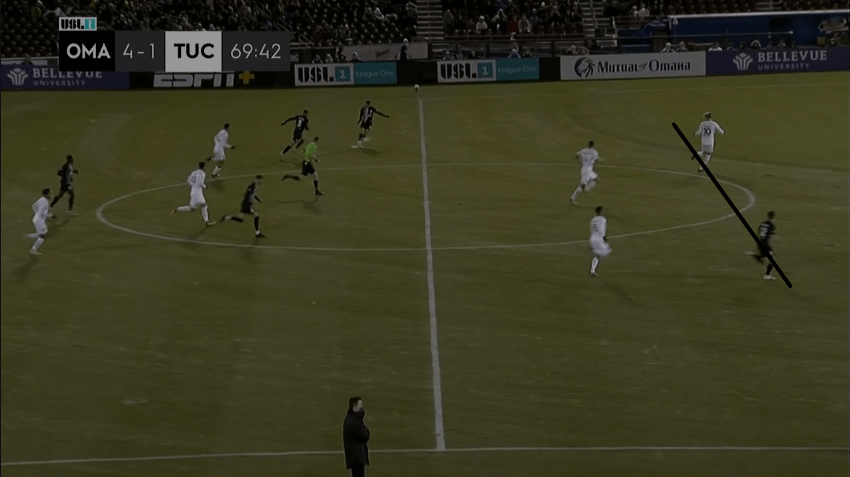
            I will give full credit to the FC Tucson players and coach Jon Pearlman – they didn’t give up.  If anything, they sped up their play, restarted play as quickly as possible, and carried themselves with the belief that even though the odds were slim, they still believed they had a chance.  Pearlman deserves credit for his adjustments following the incident.  It would be easy for a coach to panic, make immediate substitutions, and overreact.  He didn’t.  He gave his players instructions and watched the remainder of the half to see which players he could depend on.  The players that were still going all out deserved to stay on the field in the second half.  He also took time to consult with his coaching staff before halftime, and during it, to formulate their next moves.  He kept his cool, looked for options, received ideas from his staff, and reacted accordingly.  Good job, Pearlman.

            To open the second half, Jon Pearlman opted to substitute midfielder Manu Ferriol on for Mohamed Kone.  This was a smart move.  Ferriol is a speedy and fierce competitor who likes to move up the field.  Kone, whether by design or personal preference, likes to sit back.  By subbing on Ferriol, Pearlman was sending a message that his team wasn’t going to look to absorb Union Omaha’s attacks.  They were going to press hard and look for fast breaks.

            Fortunately for fans inside Werner Park, they wouldn’t have to wait long for the first goal of the second half.  In the 49th minute, Rashid Nuhu sent a goal kick into FC Tucson’s half.  Evan Conway was able to get up for the aerial duel and get a glancing header on the ball.  Not only does the glancing header move the ball up the field, but it gets the ball to the ground sooner.  This was perfect because Greg Hurst had already started his run through the FC Tucson backline.  Because the ball was directed to space and falling quickly, Hurst was in a great position to pounce on the loose ball and continue toward the net.  Hurst took one touch to settle the ball before sending a shot on goal.  Wallis Lapsley did a good job of advancing beyond the goal area as a response to Hurst as he advanced on goal.  He was trying to limit Hurst’s shooting angle and possibly force him into more touches on the ball.  Unfortunately for Lapsley, the shot didn’t deflect off his hands the way he wanted it to and the ball was served on a silver platter for Damiá Viader to slot into the lower corner.  If you’re looking for a textbook case of why you crash the goal whenever a teammate is taking a shot, consider this video an early holiday gift to you and yours.  The Owls were now leading 3-0, with 41 minutes remaining in the match.

            On the resulting kickoff, FC Tucson took a shot on goal.  It wasn’t a great attempt by any measure, especially since Rashid Nuhu was able to settle the ball of his chest.  FC Tucson’s message was clear: they were in desperation mode.  That desperation would turn to further misery when Union Omaha was awarded a corner kick in the 53rd minute.  Damiá Viader was able to send in a threatening cross, but Luca Mastrantonio successfully won the aerial battle and got his head on it.  Threat averted, or so he thought.  Waiting outside the 18-yard box was Devin Boyce, zeroing in on the falling clearance.  Executed with perfect technique, Boyce sent an absolute rocket of a volley into the lower corner of the goal.  This kind of a shot is incredibly difficult to make, but Boyce made it look easy.  Almost identical to Nick Firmino’s volley against Greenville on May 16th, Boyce showed how much confidence he’s riding on at the moment.  He had multiple defenders closing in on him very quickly, but he committed to the shot, leaned forward, watched the ball come off his laces, and had the perfect balance of power and precision.

            In the 60th minute, Jay Mims decided to make a couple of smart substitutions.  Austin Panchot was subbed on for Evan Conway and Toby Otieno came on for Devin Boyce.  The result was already in hand, so Mims was smart to let Conway start his rest and recovery early.  Removing Boyce was also smart because he was sitting on a yellow card.  It was unnecessary to keep Boyce in the game and let each passing minute be another possible opportunity for him to earn a second yellow card, forcing him to miss the Championship.

            In the 63rd minute, Kaelon Fox made a throw-in to Manu Ferriol, who continued the run down the line.  Ferriol’s door to the corner was shutting quickly, so he split Conor Doyle and Ferrety Sousa to feed a pass to Shak Adams.  Illal Osumanu was riding closely on Adams, so Adams did well to the shield the ball from Osumanu and open himself toward the middle.  All it took was a single glance to realize that there were a lot of black jerseys advancing quickly from the middle, so Adams was forced to direct the ball back toward the sideline.  Without hesitation, Ferriol sent a curling cross-field pass to midfielder Charlie Dennis.  Jake Crull was able to beat Dennis to the ball, but instead of immediately clearing the ball, Crull tried to make a cut and play out of the back.  Dennis saw through this and lodged a physical challenge against Crull.  After a balanced duel, involving pushing and pulling from both players, Dennis won the ball and dribbled into Union Omaha’s box.  He was able to deke Daltyn Knutson and found extra space closer to the penalty spot.  Not wanting to waste any more time, Dennis let loose a shot that not even Rashid Nuhu could defend.  It was a great individual effort by Dennis and showed his determination, even in the face of obvious defeat.

            Not wanting to give any sense of hope to FC Tucson, the Owls went back on the hunt.  In the 70th minute, FC Tucson was given a corner kick.  Greg Hurst was able to bring the ball down and start dribbling up the field, but couldn’t get too far before Manu Ferriol provided a challenge worthy of putting Hurst on the ground.  The resulting loose ball was quickly picked up by Toby Otieno and immediately fed forward to Emir Alihodžić.  Before even taking a touch on the ball, Alihodžić had already picked out a sprinting Austin Panchot on the other side of the field.  As a result, a long ball was fed over the FC Tucson backline and Panchot was on goal with time to spare.  I’m pretty sure Panchot was able to book FC Tucson’s flight back home in the time he took to line up his shot.  Panchot’s celebration afterward was enough to tell the FC Tucson players that their airline tickets were already confirmed.

            At first glance, it looks as though Austin Panchot is well offside, so I decided to do a little bit of work.  In the screenshot below, you’ll see that Panchot is onside.  The grounds crew for Werner Park mowed the grass such that there were different shades of grass, depending on which direction the mower traveled across that grass.  The stripping mowers and rollers, assuming these are the tools used by the grounds crew, bend the grass in opposite directions, making it easier to gauge distance and where the second-to-last defender held the line.  I used a quick photo-editing tool to simply draw a line along the delineated shades of grass closer to the half line from Panchot.  By doing this, I’m actually giving FC Tucson the benefit of the doubt because it will be a shallower line, but even using this angle between the two players shows Panchot is onside.  Because Charlie Dennis is putting on the brakes at the exact moment Panchot is continuing his run, he looks like he’s offside.  The Assistant Ref made the right call in keeping their flag down.

            In this moment, Búhos fans were treated to witnessing Union Omaha score the most goals they’ve ever scored in a single match.  During the 2021 Regular Season, Union Omaha tallied four goals on four separate occasions.  With five goals under their belt, there was only one remaining record to break: win differential.  The Owls have never won a match by more than four goals.  After Panchot’s goal, Union Omaha was sitting at four goals.  With 20 minutes left in the match, challenge accepted.

            Union Omaha fans and players would have to wait until the 83rd minute before witnessing the last record being broken.  Toby Otieno carried the ball into FC Tucson’s half and spotted John Murphy waiting for the pass on the outside.  Murphy showed good technique at widening the field as much as possible because his heels were on the sideline as he waited for the pass.  This ensures the entire ball will not go out of bounds, opens the field, and he has his hips ready to either cut back toward the half line, or to let the ball roll across his body and attack the corner.  After taking his first touch, Murphy does just that: takes the corner.  Gio Calixtro went in for a challenge, but Murphy’s touch was too quick and Calixtro was left out of the play.  Kaelon Fox, who had been marking JP Scearce, had to quickly shift toward the corner so as to not give away the goal line.  As a result, JP Scearce was wide open at the top of the box.  Murphy passed the ball to Scearce, who let his first touch take him toward the goal line and Murphy’s cut inside the box toward the penalty spot acted as a pseudo-basketball pick.  From here, Scearce aimed for the upper 90 of the far post, but Wallis Lapsley was able to parry the shot away, only for it to fall right at the feet of Emir Alihodžić, who sent the record-breaking ball into the net.

            For the first time in club history, Union Omaha was able to tally six goals in a single match and set a record for win differential with five goals separating the two sides.  Oh yeah, and Union Omaha punched their ticket to the Championship.  For the second straight season, Greenville Triumph and Union Omaha are lined up to decide the champion of USL1.  This time, however, the match will actually occur and it will be in Werner Park.

            I need to give props to FC Tucson, though.  With as much vitriol as I caste their way in the semifinal preview, this match did not do them justice.  The players fought hard and turned their season around, so it’s unfortunate that one player decided their ultimate destiny.  The FC Tucson players have every right to feel robbed of a grand opportunity.  They have every right to harbor resentment toward Maxi Schenfeld.  However, any possible resentment needs to be quickly assuaged.  The match is over, the season is over, and there’s no better time to look forward to next season than now.

Ultimately, FC Tucson should be proud of how far they were able to make it, especially when there were plenty of dark days early in the season.  There are a lot of changes to come in the offseason and the FC Tucson we saw on Saturday will not be the same team we see compete next season.  For that reason, FC Tucson should bring the players into the locker room and celebrate together one last time.  You never you know when you’ll see your teammates again, so live it up.

Let’s Get Ready to Rumble!

Union Omaha (14-9-5, #1 seed) vs. FC Tucson (11-7-10, #4 seed)

Werner Park, Papillion, Nebraska

4 PM (CST), ESPN+

            If you have a ticket to this evening’s match, the entertainment will be worth every cent spent.  The “Desert Kings” of FC Tucson have arrived and they have no intention of restoring any love lost between the two clubs after the fiasco at Morrison Stadium in late September.  I’ll address that a little later, but let’s take a closer look at FC Tucson’s season.

            John Galas was given the nod to manage the club again in 2021, after only winning six matches in the shortened 2020 season.  The team didn’t start the 2021 season strongly, seeing a placement no higher than seventh place in the first twelve matches.  After the Week 12 loss to Union Omaha, the then 11th-placed club decided to part ways with Galas and Jon Pearlman was promoted to Interim Head Coach while the club looked for their next leader.  By the end of Week 26, FC Tucson had climbed the standings all the way to fifth place and the club felt comfortable naming Pearlman as Head Coach for the rest of the 2021 season and 2022 season.  He’s no stranger to the club, though.  A decade ago, Pearlman helped found the club.  He’s done an incredible job of righting the ship, keeping the club competitive, and reinvigorating a home fan base.  For this reason, he is deservedly in contention for USL1 Coach of the Year.

            Another reason for the club’s turnaround is the hiring of Amanda Powers as the club’s first president.  She’s no stranger to the soccer landscape.  Powers was the Chief Operating Officer at New Mexico United, a USL Championship side, and helped the club set the standard for expansion club attendance, merchandise, tickets, and general fan support.  Phoenix Rising purchased FC Tucson in 2018 and helped elevate the club from USL2 to USL1.  Powers used to be a member of the USL Board of Governors, but has turned her passion toward enhancing the fan experience in Tucson.

            As far as the on-field product is concerned, the compliments stop here.  I know some of the other guys here at Who Gives A Hoot will disagree with me, but I feel confident in saying that FC Tucson is the dirtiest club in the league.  I’ve spent some time recently watching several of their previous matches and there’s plenty to speak of tactically and related to their “gamesmanship.”  If you were at Morrison Stadium on September 25th, you saw how reprehensibly they represented their club.  Whether it was late tackles, going in studs-first, off-the-ball confrontations, challenges aiming to hurt their opposition, egging on the home fans, and total lack of regard for their behavior, FC Tucson has nothing to be proud of between the whistles.  If this club is truly dedicated to a family-friendly environment at their home matches, their on-the-field product is about as far away from that as you can get.  There’s playing the sport with respect for competition, and then there’s FC Tucson’s vile display of instigation toward their opposition.  I get that these are professional athletes and winning is another way for them to earn their paycheck and livelihood, but young soccer players shouldn’t be motivated to play the way FC Tucson plays.  Enough said. [Editor’s note: Somehow Rich made it through this paragraph without mentioning they had 8 red cards this season with 3 going to a single player alone, both good for first in the league.]

            From a tactical standpoint, FC Tucson’s overall approach is based on their ability to cover the field very quickly.  The club usually lines up in a 4-3-3, but once the opening whistle is blown, there is very little attention paid to their shape.  Players quickly swarm near the ball and don’t seem overly concerned about all of the open space they created in their absence.  For example, the midfield is usually comprised of Charlie Dennis, Mohamed Kone, and Joao Delgado.  If you pay attention to their movement, these three are never in a disciplined line and are constantly overlapping one another. 

Charlie Dennis will most likely line up on the right side of their half, but he’ll cover vast distances to provide support for his team.  Dennis is one of the most valuable players on the team and there’s a strong argument to be made that he is, in fact, the most valuable player on the team.  When he’s not orchestrating attacks, he’s one of the first players to confront the opposition and often initiates skirmishes through petty off-the-ball actions.  In all honesty, he’s lucky to have not received a straight red card for his off-the-ball deliberate elbow in last week’s match against the Richmond Kickers.  Mohamed Kone usually lines up in the middle, but he typically sinks back far enough to look like a defender.  Kone isn’t particularly fast, doesn’t track players well, and doesn’t react all that quickly, but serves his purpose by shepherding attacks to the outside.  Joao Delgado isn’t as flashy as his teammates, but does well at getting up and down the field, especially providing support to right back Noah Franke.

            I’ll do a quick shoutout to Noah Franke because he played his collegiate years at Creighton University (2014-2017).  In his four years, he started in 57 matches, scored 6 goals, and provided 14 assists.  There is a lot of hype surrounding Franke and there are those who believe that he is the best right back in the league, which is supported by the fact that USL Championship teams are showing interest in his abilities.  He joined FC Tucson in April of this year and has been a tremendous source of stability in their defense.  While he is playing for the opposition, it’s still nice to see someone familiar with the area finding success beyond his collegiate career.

            The starting forwards will likely be Deri Corfe, Shak Adams, and Kevin Rodriguez.  These three do a fairly good job of minding their sides of the field, but can still be found providing assistance wherever needed.  Deri Corfe is a creative attacker and a consistent instigator.  He knows how to get under the skin of his opponents and he capitalizes on every given opportunity.  Shak Adams is a pure striker.  He’s explosive, loves to dribble at opponents, and loves to put on a show.  This frontline is fast, eager, and physical.

            There are going to be some matchups that will provide nonstop entertainment throughout the match.  The matchup I’m looking forward to the most is between FC Tucson’s Shak Adams and Union Omaha’s Damiá Viader.  Both have plenty of speed and skill to go 1v1.  Another matchup will be the duo of Union Omaha’s Greg Hurst and Evan Conway against FC Tucson’s backline.  Kaelon Fox and Maxi Schenfeld are the equivalent of hockey enforcers on a soccer field.  It’ll be nice to see how much Hurst and Conway can embarrass them from start to finish.  After the deplorable behavior between Fox and Schenfeld at Morrison Stadium, a little humbling could serve them well.

            Union Omaha has a great opportunity before them.  FC Tucson plays open and disregards a lot of space in doing so.  The Owls should be salivating at the offensive opportunities they’ll be gifted this evening.  These two clubs have played one another six times over the last two seasons and Union Omaha won five of them.  They know how to beat FC Tucson.  They’ve done it before and they should be able to do it again today.  Assuming they don’t get sucked into too many skirmishes and retaliations, they should be able to send FC Tucson home with more than a plane’s cargo hold full of broken dreams.

            Before you head to Werner Park, make sure you check out the updated parking arrangement.  With the holiday lights occupying a large portion of the parking lot, Union Omaha announced alternative parking and entrances.  If you are willing to join the carpool caravan, Omaha Parliament will be having a pregame get-together at Pint9 from Noon to 3 PM.  There will be plenty of beverages, discount merchandise, a food truck, and a chili cook-off.  Multiple people will be vying for your vote during the cook-off, so bring all of the loose change you have and use the coins as your votes.  At the end, prizes will be handed out and all of the money used in the voting process will be donated to Football for the World, a charity with a quality mission and who is active in the Omaha area.  It’s going to be a great day of USL1 playoff soccer, so don’t forget to check out the latest episode of the “Who Gives A Hoot?” podcast, featuring an interview with the man, the legend, Greg Hurst.  You’re not going to want to miss out on his conversation with Luke, Ryan, and Ben.  See you at the stadium.  ¡Viva Búhos!

The importance of fans

Momentum is a funny thing, one second you have it, and poof, the next it is gone. It is the difference in winning and losing. Hitting the shot, and missing it wide left. When I think of momentum building moments in sports, I am struck by visions of Divok Origi scoring 6 minutes into the second leg of the Champions League vs Barcelona, igniting Anfield and starting the 4-goal thriller to win 4-3 on aggregate. Watching the Nebraska football team go up 3 points on Wisconsin only to watch them give it all away on the very next play. What did those two games have in common? Fan engagement. What the fans felt the players felt. Momentum is built with the fans of the game; we can be the difference. 

You see examples of it everywhere you look in sports. The chanting, the union, the passion. The players can hear it, and they feed off it. It is that extra spark of energy when down to find that next gear. To finish the game out with the same intensity they started with.  

Nebraska; and specifically, Omaha is a city of passion. We work hard, we put 100 percent of ourselves into whatever we are doing. That same passion carries over to our sports. You see it in the supporter’s sections on both ends of the pitch. You see it in the random guys in section 105 yelling at the guys in long sleeves. The players see it too. They acknowledge us when they hear us, they give a nod or a grin on the throw in, and end the match saluting all sides of the pitch. And you better believe that passion seeps into their muscles and fuels the extra effort they put in. Conversely the fans not being engaged and being down and pessimistic in the stands has the exact opposite effect. Which you see when a tough goal is given up and some fans deflate.  

Union Omaha recently put out a question-and-answer session with Coach Mims, and I asked about how the fans feed into the energy of the team. His response was genuine and complementary of our fans. He starts by acknowledging the challenges we all face playing in a dual-purpose stadium. “We all know it can be challenging; but for how challenging it is we’ve done an amazing job here. And that’s a credit to you fans and the supporters groups” said Mims. We all know that the acoustics are not on our side with how open the stadium layout is, being that it is a baseball stadium. But with that being said he also said that it has been “really, really good”. The noise is constant and is heard by the team and coaching staff. “Its amazing, it doesn’t stop, it just keeps on going and going” They hear everything from the drums to the chants and the constant noise, and Coachs and the players appreciate it. “Weve taken a challenging environment and made it amazing”. 

Coach Mims then talked about how well we as fans have done to come to the game every week. “We won the attendance title again” He said while pumping his fist into the air, “It has to do with a lot of you supporters so thank you for that”. It is a huge accomplishment for this club and this culture we are cultivating in Omaha. With Werner Park being a baseball stadium and well established in the minor league baseball system the stated capacity is 9,000 fans. Union Omaha in only its second season has averaged more than 1/3 the capacity with 3,177. This figure is also better than 14 of the USL-C sides, according to Soccer Stadium Digest. 

With the product that is being put onto the field and the strength and passion that our supporters continue to show week in and week out this club can truly grow into something even greater than it already is. The team now needs out continued support to go into these playoffs strong and bring that title home where it belongs; To reward this team that’s worked so hard and these fans that have given their lungs and vocal cords week in and week out.  

USL League One Playoff Preview: Round 1

So it seemed like the entire second half of the season for the middle of the table was a giant knot in a fishing line that you have to go in a million different directions to untangle.  Toronto FC II’s win over New England Revolution II on Friday made the actual Decision Day a little less dramatic, but we were all given a little bit of a treat as the final game of the season was played on an island and did have an impact on finalizing the bracket for the USL League One playoffs.  And of course, some of these team’s seasons have finished on a rollercoaster ride similar to that of the entire mid-table collectively, making the first round of the playoffs this year incredibly competitive.  Let’s go over each of these matchups and see what we need to watch out for.

Match 1: #3 Chattanooga Red Wolves SC v. #6 North Texas SC
CHI Memorial Stadium
Saturday, November 6: 18:00

If not for Nicolas Firmino’s goal from the spot during stoppage time of their 1-1 draw against Union Omaha, North Texas would be hosting a playoff game against FC Tucson.  Instead, one of the hottest teams in the league, that can also rotate its roster at the drop of a hat, travels to play a Chattanooga team that as recently as a month and a half ago had no reason to believe they would even have to play a match this weekend.  On September 20 Chattanooga were top of the table and had a nine point cushion between themselves and Greenville Triumph with only six matches remaining for each.  Chattanooga would only net four points out of those six matches, with three of their four losses in that stretch coming from teams that failed to make the playoffs.  Meanwhile, North Texas grabbed 14 out of a possible 21 points in their last seven, and have corrected the course from their early season struggles on the road.  North Texas haven’t lost a match on the road since a 2-0 defeat at South Georgia Tormenta on September 11.

These two clubs played four times this past season, with Chattanooga holding the advantage with two wins and two draws.  Their last match ended 1-0 in Chattanooga, and it was practically a bookend for each team’s midseason stretch.  For Chattanooga, it was the last of their league best 15 match unbeaten streak, after which they lost at home to Greenville and haven’t been the same since.  North Texas’ next match was the before mentioned loss at Tormenta, which was followed by a draw in Omaha that started their successful season ending stretch.  Everything appears to be coming full circle with this one.

So, what can we expect in this match based on what we saw during the regular season?  An incredibly physical game.  Chattanooga finished second in the league in bookings this season at 73 (not quite 3 per game), but it was North Texas that drew the official’s ire more often when these teams played.  19 cards were shown in their four matchups this season, and 12 of them were shown to North Texas.  It will be interesting to see if North Texas start any of their players that have experience in MLS with FC Dallas this season.  Only five players have made appearance for both teams this season, and Eddie Munjoma and Kalil ElMedkhar have been the only two players that have consistently been playing for North Texas lately.  However, going against the grain of North Texas typical rostering strategy, the two have been playing both home and away matches these past few weeks.

Because this is the first match of the weekend, we will know how the playoff bracket is distributed by the end of it.  If Chattanooga wins they will play at Greenville in the semifinal, and Omaha will host the winner of the second match.  If North Texas wins they will head to Omaha, and Greenville will host the winner of the second match.

Match 2: #4 FC Tucson v. #5 Richmond Kickers
Kino Sports Complex
Saturday, November 6: 21:00

Over the course of the entire season, FC Tucson essentially experienced streak, after streak, after streak.  After a 4 game winless stretch before the end of June, John Galas was out as head coach and replaced with Jon Pearlman.  A Pearlman led squad went three matches without a loss before freefalling and dropping four straight.  They immediately followed that with a stretch that ultimately allowed them to be in the position to qualify for the playoffs, a 5-2-0 stretch (of which five matches were on the road) and they outscored their opposition 16-6.  They beat Richmond at home in the very last match of the season to qualify for the playoffs, a Richmond Kickers team that embodied the very definition of a mid-table club virtually all season.  Along with Union Omaha, they were the only club this season that never had a winless stretch of more than three matches.  However, In Richmond’s case it took them a while to win back-to-back matches.  They didn’t win a second consecutive match until October, but they made that part of a five game winning streak that helped earn their playoff safety before decision day.

Richmond and Tucson played each other twice this season, splitting the difference in two matches that reflected how Richmond essentially lived and died by the performance of goalkeeper Akira Fitzgerald.  The first match was a 1-0 victory at home for Richmond back in July, where their lone goal came from an Emiliano Terzaghi penalty.  Richmond’s overall effort managed only one additional shot on target that night, while Richmond’s defense allowed Tucson to pepper the frame with shots, all eight of which were saved by Fitzgerald.  The season-long matchup found balance in the end, as Tucson would put four of their seven shots on target past Fitzgerald the next time in their 4-2 victory this past weekend.

While the first playoff game on Saturday has a strong likelihood of being a physical grind, this one could possibly be a full throttle shootout.  86 goals were scored in FC Tucson games this season, second most in the league behind Fort Lauderdale CF.  Nine Tucson games had at least four goals, including each of the last three.  Richmond’s defense performed much worse on the road this season than at home, giving up 25 goals in away matches this season vs. only 11 at home.  Signs point to a huge Tucson advantage here, but these teams played each other just this past weekend, and rematches like this tend to be more competitive as teams are more familiar with each other’s recent form.  How Richmond responds to all of the traveling will likely be the most important factor that determines how this match will go.

Contest Between Clinchers

North Texas SC (10-8-9, 5th place) vs. Union Omaha (14-5-8, 1st place)

Globe Life Park, Arlington, Texas

7:30 PM (CST), ESPN+

            Isn’t it nice to be able to sit back, relax, and not worry about tonight’s results?  Even though Union Omaha plays North Texas, it sure feels like a bye week.  Both clubs have clinched a spot in the playoffs, Union Omaha has clinched first place, and Búhos Nation is in high spirits.  North Texas still has a chance to rise as high as third place tonight, so they have a reason to compete tonight.  Tonight’s match could be the last time these two clubs compete against one another, so Union Omaha has an opportunity to remain undefeated against them.

            North Texas has only lost once in their last five matches, as well as once in their last five matches at home.  This club has been hot and cold all season, though.  One week, they’re in 11th place.  Another week, they’re in 3rd place.  Despite the ups and downs, the club has gravitated close to the 5th-7th place mark.  Their current placement doesn’t come close to describe the kind of club they are, though.  They are young, eager, aggressive, and highly disciplined.  Most of the club’s troubles have come as a result of being on the road.  At home, the team has only lost twice.  Tonight could very easily be their last home match in the USL, so you know they are looking for a reason to set off some fireworks tonight.

            Union Omaha comes off a great effort against Richmond.  The 2-0 win was sparked by Toby Otieno’s magical free kick in the second half.  Not long after, Greg Hurst filed the insurance policy with a goal of his own.  The team battled hard, finished strong, a deserved every second of their celebration in the locker room afterward.  Depending on coach Jay Mims’s focus, tonight could an opportunity for other players to get more playing time.  By resting the starters, or players carrying heavy minutes on their back, Jay Mims affords his players respite for the next couple of weeks before they host the semifinals on Saturday, November 13th.

            These two clubs have faced each other five times and Union Omaha has never lost to North Texas.  In fact, since the first match they played (a Union Omaha win), every match has resulted in a draw.  This season has seen three draws – two at Werner Park and one at Globe Life Park.  The last time Union Omaha played in Globe Life Park, it looked like North Texas was on their way to victory, but a late opportunity from Damía Viader to Evan Conway saved a point for the Owls.  Every contest between Union Omaha and North Texas has been a battle of will.  They’ve all been fiercely contested and full of impassioned challenges.

            This sounds like an insult, but I promise it isn’t: North Texas doesn’t have any stars that really shine in their squad.  Instead, they truly work together as a team.  They are very controlled, disciplined, and rooted in their fundamentals.  When the defense wins the ball, they are meticulous in their effort to play out of the back, advance the ball up the field as a unit, and develop their chances after establishing themselves in the attacking third.  North Texas likes to cross the ball into the box, but are just as happy attempting to dribble the ball through a couple of players.  They do have two large weaknesses: defensive windows allowing opponents to shoot on goal and containing their emotions.  Their defense has allowed far too many shots on goal, even shots in general.  They haven’t quite figured out how to fill the windows, step up to shooters, and take a load off of the goalkeeper’s hands.  As for their emotions: they ride their emotions too often and it gets them into trouble.  While they don’t concede a lot of fouls, the fouls they do commit make it easy for the referees to hand out cards.  I don’t anticipate too much feistiness from them tonight, though.  They’ve already clinched the playoffs.  There’s no need to get themselves in trouble and have players missing next week’s playoff matches.

            Since Halloween is tomorrow, break out your costume a day early and head over to a Union Omaha watch party to join the costume contest.  At Rathskellar, there will be prizes handed out during their costume party.  The watch party will be outside, with some room inside available, as well.  The “Who Gives A Hoot?” podcast has had some great banter, so make sure you are up to date on those episodes.  Parliament will have merchandise available for purchase and there are some truly nice pieces to buy: scarves, stickers, buttons, etc.  If you haven’t purchased your tickets to the November 13th match at Werner Park, make sure you do that.  Don’t be afraid to spread the word to all of your friends, family members, neighbors, Uber/Lyft drivers, and DoorDashers.  We need to fill Werner Park and make sure the Owls feel the love that night.  Have fun at your watch parties.  ¡Viva Búhos!

Clash with the Kickers

Union Omaha (13-8-5, 1st place) vs. Richmond (11-7-8, 4th place)

Werner Park, Papillion, Nebraska

6 PM (CST), ESPN+

            Alright, let’s address the elephant in the room: Yes, Union Omaha played poorly during the match on Wednesday against Forward Madison [editors note: you can say that again]. We don’t need to dwell on it.  Instead, we need to turn our attention to the next opponent: Richmond Kickers.  If you’re wondering whether or not you should attend Saturday night’s match, stop thinking.  Just go.  It’s the last match at home in the regular season and unless you’re traveling down to Texas next week, you won’t be able to see the Owls play live for a few weeks.  Richmond is a good club, too.  They haven’t locked up a spot in the playoffs yet, so they’re hungry for some points, but you know what?  Union Omaha is mad beyond words.  You saw it on the field, you saw it on their faces walking to the locker rooms, and in the post-match video with coach Jay Mims, you could see on his face, too.  This match is about more than Richmond.  It’s going to be a crystal clear message to the rest of the playoff teams about playing in Werner Park.  Inspired by Dante’s “Inferno”: “Abandon all hope, ye who enter here.”

            Richmond is undefeated in their last five matches, outscoring their opponents 8-3.  Entering Week 25, the Kickers were in 11th place.  Of all the clubs who haven’t qualified for the playoffs yet, Richmond is the hungriest of them all.  Throughout those five matches, they took down playoff contenders left and right: Toronto FC II, Chattanooga, Forward Madison (twice), and North Texas.  That’s no walk in the park.  They’re hot and nobody can seem to slow them down.  At this point, only three clubs can catch them in the standings, but Richmond isn’t looking back with caution.  They’re looking up the standings with reckless abandonment.  No matter what happens in other matches, if Richmond wins, they’re the new occupier of third place.  While they may not be the strongest opponent on the road, they are certainly hungriest.

            Union Omaha is a club out for redemption.  How can the top club in the league drop three home games in their last five and expect to win the championship?  Nevermind that.  Don’t dwell on the past.  Instead, get excited for one heck of a match to be played in Werner Park.  We’ve all seen the action movie where the protagonist gets knocked to the ground, gets up, gives a simple shrug of the shoulders and a shake of the head, and dives back into the melee.  That’s exactly what you’re going to see Saturday evening.  Other clubs need a bulletin board full of material to get pumped up for a match.  Union Omaha simply takes the field ready to break loose of their warm-up chains.  The stadium lights are on and the crowd is there supporting them.  Once that whistle blows, it’s game time.

            These two clubs have only faced each other twice in the past two seasons.  Last year, Richmond dealt Union Omaha their first home loss in franchise history (1-0, September 26th, 2020).  In their meeting on June 19th of this year, the two sides fought to a 1-1 draw in Richmond, Virginia.  Don’t walk into Werner Park and expect to see a lot of goals.  This match is going to be a major test of mettle for both sides.  Challenges will be physical, tactics will be cerebral, and the fans will receive a great gift in return – a truly fun soccer match to watch.

            In order to plan for Richmond, there are two enormous factors you have to consider: forward Emiliano Terzaghi and goalkeeper Akira Fitzgerald.  Terzaghi has the most goals (17) and most shots (61) in the league.  He’s pretty much locked up the Golden Boot at this point.  The next closest count for each category on the Kickers is Jonathan Bolanos with 4 goals and 34 shots.  Fitzgerald, on the other end of the field, has the most clean sheets (10) and most saves (84) in the league.  While the offensive scheme seems to work through only one man, Fitzgerald has two stalwarts in front of him: defenders Ivan Magalhaes (6’1”) and Jalen Crisler (6’4”).  These two don’t seem to care one bit about playing out of the back.  As soon as they get ahold of the ball, rest assured that they are going to kick it high, wide, and away from their goal.  It’s an old-school approach to defense: as long as the ball is far away, I’ve done my job.  Their style of play is a direct compliment of Union Omaha’s style of play.  Let’s discuss.

            First off, when you look at Terzaghi’s goals, he’s not flashy.  What he is very good at is taking advantage of a ball-watching defender, slipping to the back post, and positioning himself for a far-post feed or a loose ball in the goal area.  He’s the clean-up crew.  A lot of his goals are simply picking up the loose ball and slotting it home or simple tap-ins.  If Union Omaha can put a spy on him (have someone mark him wherever he goes) and body up to him closely, I have high confidence that the Owls can make him disappear. 

Richmond is used to playing in low-scoring affairs, but that’s not good news for them.  The Kickers have played 12 away matches and 8 of them were determined by a goal or less.  Of those eight matches, they were only able to win one match and draw twice.  Union Omaha has played 13 home matches and 9 of them were decided by a goal or less.  Of those nine matches, the Owls won twice and drew four times.  Union Omaha has fared much better in close competitions, which is due in part to Richmond’s defensive strategy.

As stated earlier, they like the dump the ball back down the field at the earliest threat against their goal.  By doing this, they’re essentially giving the ball back to their opponent, allowing them to reset, and have another go at the goal.  This is good news for the Owls because it will generate more opportunities on net and increase their confidence and creativity.  Even on offense, Richmond doesn’t make a lot of passes.  They play a very direct style of soccer, where everything plummets downhill very quickly.  If Union Omaha can stay composed and move the ball around, they are sure to have bountiful shots on goal.  The Owls may have to lower the number of crosses they put into the box.  Instead, if they can take control of the middle of the field and create havoc in front of the goal, they may have more opportunities versus crossing the ball into the box.  In all honesty, they didn’t look too good in the air on Wednesday, so more possession in the final third might be a better route.  If you see Union Omaha loading the front line, you know that they’re going for crosses.  If they could overload the front line while making overlapping runs, they could confuse the Richmond defense into thinking a designed air-based play is coming up, when a thru-ball is actually about to be played.  We’ll just have to wait and see.

Now we have to consider a possible pitfall for the Owls.  Richmond like to foul and when I say foul, I mean foul.  They’ve conceded 403 fouls (1st in the league), been awarded 74 yellow cards (1st in the league), and also been awarded 3 red cards (tied for 4th in the league).  I bring this up because Union Omaha hasn’t fared well against clubs that foul so much.  This is why Union Omaha’s mettle will be tested on Saturday evening.  The playoffs are just around the corner and each opponent is going to be fighting tooth and nail to better their chances of victory.  The Owls absolutely need to step up to the challenge, without losing focus of the score line.  It’s okay to get into very physical challenges, as long as the focus is the ball and not the opponent.  As Bernard Shaw once wrote, “Never wrestle with a pig.  You just get dirty and the pig enjoys it.”

As you make your way to Werner Park, start to think about how you’d like to spend your November weekends.  The first playoff match for Union Omaha will be on Saturday, November 13th.  If you’re a season ticket holder, log onto the Union Omaha ticket website and renew your tickets.  Here’s the crucial part: how many other people can you encourage to come to the matches?  Think of anyone you’d like to bring with you.  Groups of 15 or more can get tickets for $10/each.  If you’ve been to Werner Park for Union Omaha, you’ve likely walked out after the match was finished and thought, “That was fun.  I should do this again.”  Why not share the wealth with people who are soccer lovers? Or maybe those that like the sense of community amongst fans?  I also address this issue because Union Omaha has a very good chance of hosting a semifinal match, as well as the championship.  The team needs every bit of our support as they strive to finish on top.  Every person that walks through the gates is another voice of support for the squad.  We need to be there for them, so start looking at your calendars and spreading the word.  One Means All!

Make sure you get to the stadium early on Saturday evening.  Another well-supported tailgate is already in the works.  It seems like a lot of people have made recent purchases, so make sure you’re able to pick those up at the tailgate, as well.  If you aren’t caught up with the podcast, make sure to listen to whatever episodes you can.  There’s been some fun action going on with that lately.  It’s going to be another chilly evening, so please dress accordingly.  We want everyone to have a good time and stay warm while doing so.  See you at the stadium.  ¡Viva Búhos!