Another Owl Returns for 2022

It’s Tuesday and that can only mean one thing for Union Omaha and Búhos Nation: more club roster announcements.  Today’s announcement brings news of a familiar Owl returning to Omaha for the 2022 League One season.

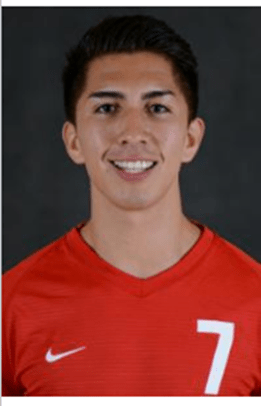
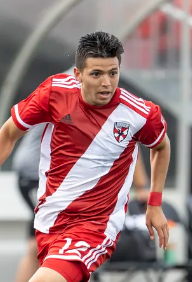
            Yoskar “Edu” Galvan-Mercado has signed a contract with Union Omaha at 18 years old, making him the youngest professional signing in club history.  This isn’t unfamiliar territory for Galvan-Mercado, though.  In August of 2021, he signed the first-ever academy contract in club history.  By the end of the 2021 season, Galvan-Mercado played a total of 39 minutes, but seemed to have left a greater mark on those around him than his minutes could ever show.

            In today’s press release from Union Omaha, coach Jay Mims said:

“We are thrilled to be a part of this exciting process for Yoskar as he has a bright future ahead and his dream has become a reality.  Through the Union Omaha and USL partnership with Bellevue University, he will now be able to continue his education while playing professional soccer, which was important to all of us.”

            In the same press release, Yoskar was quoted as saying, “I’m thankful and blessed to have the opportunity to sign my first professional contract.”  Referencing the aforementioned dream, Galvan-Mercado said, “It’s been my dream since I was a little kid, and I’m making this dream a reality.  I can’t wait to be able to play in front of our amazing fanbase again – Viva Búhos!”

            Yoskar graduated from Lexington High School and impressed analysts during his time with the Minutemen.  Galvan-Mercado played in the 2021 Class B State Finals, named to the 2021 Boys Super-State Second Team, and was also named to the Class B All-State Team.  He spent his time playing club soccer with Gretna’s Elite Academy, as well.  Now that he has signed his professional contract, he can play professional soccer while attending college and it will only be a short drive away from his hometown.

            Galvan-Mercado brings youth and eagerness to a full Union Omaha midfield and will learn plenty from the club veterans.  Coach Jay Mims also expressed excitement after signing Yoskar to his academy contract last year:

            “Players like Yoskar do not come around often.  He is a special player who has such great imagination and joy when he plays but also has a competitive edge to him.  His ability to think and see the game at such a high level for being so young is encouraging.  I am excited to help Yoskar continue to develop on and off the field over the upcoming years.”

            It will be interesting to see how Galvan-Mercado fits into the system, but there’s little doubt that coach Mims will find the best version of him and enhance his own system along the way. The 2022 League One season is going to be an exciting one, so make sure to purchase your season tickets. You’re not going to want to miss out on 2022 League One action.

            Tuesdays have become a cherished day of the week for club announcements, but in between those weekly holidays, make sure to check out the latest that Who Gives A Hoot has to offer.  It may be the offseason, but the podcast hasn’t slowed down a bit, so go to your favorite podcast-streaming service and listen to the latest episode.  We’ll keep you updated with Union Omaha club news, analysis, and a little bit of fun banter, as well.

Dion Acoff Joins Union Omaha

When Union Omaha simply tweeted, “Tuesday,” fans had no idea what to expect.  The anticipation for today paid off as the club announced two signings in the same day.  One of the two signings, Dion Acoff, has joined the club ahead of the 2022 League One regular season, which kicks off for the Owls in 67 days.

            The 30 year-old forward is familiar with the Omaha area, having played for Creighton University from 2009 to 2011.  In his 58 appearances with the Blue Jays, Acoff scored 5 goals and collected 16 assists.  After the 2011 season with Creighton, Acoff spent the 2012 season in his home state of California with the University of California at Santa Barbara.  In his single season with the Gauchos, he was able to score 1 goal and earn 3 assists across 22 matches, in which 19 appearances were starts.  In each of his three seasons playing in the Missouri Valley Conference, Acoff was the recipient of a slew of awards, such as MVC Freshman of the Year, MVC All-Freshman Team, MVC First Team, NSCAA All-Midwest Region Second Team, MVC Second Team, MVC Offensive Player of the Week, and College Soccer News National Team of the Week.

            After performing well in the college ranks, Acoff continued to excel as a professional.  His first professional career started in 2015, with a stop at Knattspyrnufélagið Þróttur in Iceland.  Acoff played for the Köttarar, or “Meat Eaters,” in 40 appearances, scoring 9 goals along the way.  During his time in Iceland, he also played for Valur, where he was able to showcase in skills in the UEFA Champions League and Europa League.  While playing for Valur, Acoff made 32 appearances and scored 6 goals, winning the top Icelandic league twice, the Icelandic Super Cup twice, and the League Cup once.  In 2019, Acoff joined Seinäjoen Jalkapallokerho (SJK) in Finland, before returning to Iceland in 2020 with Grindavik.

            Returning stateside brings Acoff back to familiar territory, under the familiar coaching of Jay Mims, and allows him to reunite with a fellow former Blue Jay, Conor Doyle.  In the press release from the club, Mims said, “I have known Dion since he was in high school and have always enjoyed watching him play.”  Referencing his international experience, Mims noted that Acoff “…brings plenty of experience by playing in 1st divisions in Europe over the last several years and I am excited to reconnect with him over the next few years.”

            In the same press release, Acoff said, “I am really looking forward to being back in the states and playing in Omaha again.”  While complimenting Union Omaha, he said, “I am excited to be a part of this organization and the community.  Omaha is where it started for me back in college so to come back and play here is something special.”

            In the videos below, you’ll see that Acoff can punish the opposition if he’s given space.  Almost all of his videos show him playing strictly up and down the sideline, but he doesn’t let that stop him from providing quality crosses and low-driven passes into the box.  If he’s given time and space, he is a dangerous player, especially in build-up play into the attacking third.  He should be a valuable member of the offense, collecting quite a few assists throughout the season.  While he has the history of playing as a forward, he shows a lot of value along the sideline as a midfielder.  Mims will do a great job of coaching Acoff to fit into his system perfectly.

            With these two signings, Union Omaha now has eight players signed to the 2022 season.  The club opens their title defense on April 9th in Madison, Wisconsin against Forward Madison FC.  The Owls play their first home match on April 23rd in a first-time matchup with Central Valley Fuego FC.  If you haven’t purchased your season tickets yet, make sure to head over to the club’s website or call the ticket office to be a part of the exciting action this upcoming season.

Union Omaha Signs Noe Meza

While some people in the Omaha area are elated to hear the news about a second elephant being born at the Henry Doorly Zoo, Union Omaha fans are overjoyed to hear about another owl joining the club.

            On Tuesday afternoon, Union Omaha announced the signing of forward Noe Meza.  The 23 year-old comes from Sunnyside, Washington and played collegiate soccer at Seattle University. The new signing brings a wealth of experience from his young career.  After redshirting for the Redhawks in 2016, Meza went on to appear in 62 matches, starting in 44, and scored 21 goals, including 6 game-winning goals and a hat trick.  He was even given the opportunity to showcase his talents at the NCAA Tournament, where he scored against Stanford.  His play on the field attracted several accolades, including Team of the Week nominations, First Team All-WAC, All-WAC Second Team, and WAC Tournament MVP.

            In the club’s announcement, released earlier this afternoon, Union Omaha coach Jay Mims said, “Noe is someone I have tracked for several years and I have enjoyed watching his development.”  When describing how Meza would fit into the lineup, Mims said Meza “…is a versatile player who can play in a number of different positions including up front, in the midfield, or in the back.  He comes from a super program and I am excited to help Noe develop into a good professional on and off the field.”

            Noe Meza released a short statement in the same press release from the club, saying, “I’m very excited to join such a great club and city.”  He also complimented the club and said, “The club’s recent history has shown a culture of winning.  I look forward to helping bring more success.  I can’t wait to play in front of an amazing fan base.”

            Looking at Meza’s scouting film and highlight reels, he looks like an intelligent team player with soft feet and good finishing skills.  He makes good runs up the field after passing to a teammate, has good composure under pressure, and has good instincts in the build-up of plays.  Most of his film shows him playing out of the middle, but also shows his comfort level along the sideline and movement between the two areas of the field.  That kind of freedom comes from a coach who is comfortable with the skills in his player and trusts his instincts.  His height may limit him in aerial battles in League One, but his film also shows that he is good at winning the second ball and redirecting shots or headers on goal.  He also shows the ability to draw fouls around the penalty area.  This could become a valuable asset for the club during set pieces.

            Noe Meza is one of two signings from the club today, so be on the lookout for the second article, in which we highlight the second addition to the team and welcome another owl to the community and our collective family.

            Stay tuned to Who Gives A Hoot for even more analysis and thoughts on the recent club signings through our articles and podcast episodes.  It may be offseason for the club, but the banter never quits on the podcast, so check out the latest episode to hear your favorite voices break down the latest club and league news, with a healthy sprinkle of miscellaneous news to keep you on your toes.

Damià Viader to Toronto FC?

With 4 players signed to USL-Championship clubs so far this offseason, another Owl could soon leave the nest and be on there way to another club.  This time, the player involved is Damià Viader.

          In late December, Union Omaha announced the re-signing of Damià Viader for the 2022 League One season.  The 23 year-old Spaniard was named League One Defender of the Year in 2021, as well as Most Valuable Player in the Championship Match, so it shouldn’t come as any surprise that his efforts turned the heads of those at larger clubs.  The most recent suitor is Toronto FC, the winners of the 2017 MLS Cup.

            Earlier today, Toronto FC announced a 34-player roster for a preseason camp in California.  Viader’s name was included among the names released to the public, but only as a “Trial” player.  When he laces up and hits the field, he’ll be joined by likes of Michael Bradley, Sebastian Giovinco, Alejandro Pozuelo, and newly-appointed coach Bob Bradley.  The camp is expected to extend into early February, as the club continues to prepare for its first preseason match, scheduled for February 26th against FC Dallas.

            After “The Reds” finished the 2021 MLS regular season ranked 13th in the Eastern Conference (26th overall), the club currently finds itself in rebuilding mode.  The club is filled with veteran experience, but the aging presence wasn’t the best fit for then-coach Chris Armas, who preferred to play a high-pressing, fast-paced style.  After Armas was fired, Javier Pérez filled in for the remainder of the season.  Upon the conclusion of the season, Toronto FC opted to bring in the well-established Bob Bradley for the 2022 season.

            So how will Viader fit into the system at Toronto?  Well, the Reds currently have glut of attackers ready to make Bradley’s style of play work in the East.  While Bradley coached Los Angeles FC from 2017 to 2021, his team often displayed a healthy balance of pressure, possession, and flashy play.  In fact, the 2021 LAFC squad possessed many 1st and 2nd-placed rankings in year end statistics, including goal differential, passing, and shots.  This style certainly plays to the strengths of Viader.

            As Union Omaha fans saw time and time again, Viader has the abilities and determination to make plays on both ends of the field.  He spent almost all of his time along the left sideline, but exercised good judgement in floating toward the middle to support his teammates during the run of play.  Viader also showed exceptional ability to produce chances in the box with his efforts along the sideline.  With his passes and crosses, he was able to create a league-leading 61 chances, resulting in 6 assists. [editor’s note: Dami generated a league leading 8.33 xAssists over the last two seasons #datadump]

            Bob Bradley’s style has evolved a bit over the course of his career, but with the offensive weapons available at Toronto FC, especially with Viader’s possible inclusion to the roster, he could end up with a high-powered offense.  Make no mistake: Bradley likes to press, but it’s not the all-out blitz type of press that Armas tried to employ during his short tenure at the club.  Bradley has a more patient press, if that makes any sense at all.  His LAFC squad forced a lot of turnovers and quickly moved up the field on the counter-attack.  Another prominent note from his time in Los Angeles was how much time the ball spent in the middle of the field, right outside of the 18-yard box.  Viader would be a valued member of the distribution team, especially from the point of the turnover to assisting the goal at the other end of the field.

            Of the 11 defenders invited to the preseason camp, only three players have a history of playing on the left side: Rohan Goulbourne (19 years old, Toronto FC II (and one time IWCC player)), Luca Petrasso (21 years old, Toronto FC II), and Damià Viader.  While Petrasso is a true left-back, Goulbourne has also spent time as a left-wing.  As for the 2022 Toronto FC roster, there are already two left-backs on the payroll: Kemar Lawrence (29 years old, Jamaica, contract ends in 2024) and the already-mentioned Luca Petrasso (21 years old, Canada, contract ends in 2023).  Lawrence made 25 appearances with the Reds last season, while Petrasso earned 28 appearances with TFC2.  On January 11th of this year, Petrasso signed a Homegrown Player contract with Toronto FC that will last through 2023.  Viader will have some competition at the camp, but he should be able to impress players and coaches alike.

            The left-back position doesn’t seem to be very high on the scale of importance for Toronto FC at the moment.  Being that the club is in the process of rebuilding, the Reds are looking to possibly re-sign forward Sebastian Giovinco, after selling him to Saudi Arabia’s Al-Hilal FC in 2019.  Giovinco would have to enter the MLS Allocation Order and Process, of which Toronto FC occupies the third position.  The club is also focused on opening a Designated Player spot, as well as money, for the incoming star forward Lorenzo Insigne.  Another big-name player that could potentially make the move up north is center-back Carlos Salcedo.  In doing so, the club would likely have to release players like midfielder Yeferson Soteldo and forward Jozy Altidore.  With all of these moves, the club could very easily find comfort in the way of Lawrence at left-back and keep Petrasso as his backup, in order to avoid any additional financial moves (i.e. Damià Viader).  Of course, there are ways in which Viader could be brought into the club, while keeping the books in order, but that’s a matter for their financial officers to handle.

            Obviously Búhos Nation would appreciate Viader’s presence on the field, but he deserves to reach high and strive for his full potential.  Even though that potential may not be reached while playing in Omaha, he can rest easy knowing that he made a huge impact on the club and will have plenty of fans supporting him from afar.  Once an Owl, Always an Owl.  So from those of us here at Who Gives A Hoot: best of luck at the preseason camp, Dami. [editor’s note: Don’t be afraid to show them your greatness!]

2022 Union Omaha Regular Season

It’s the season of giving and USL League One generously gave their fans a big gift: the schedule for the 2022 regular season!  With 11 [editor’s note: all independent!] clubs competing in the league next season and the league sticking with 30 matches per club, it makes perfect sense for the league to design a schedule where each club plays all of the other clubs in the league three times throughout the season.  Now that the schedule has been finalized and released, let’s dive into Union Omaha’s schedule and find some of the hidden treasures and traps along the path to the postseason.

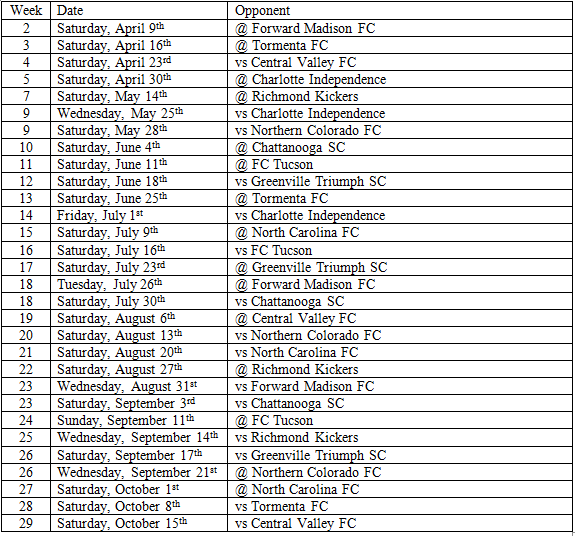
Before we get started, here’s a quick rundown of the 2022 Union Omaha schedule:

For the third year in a row, Union Omaha gets to watch other clubs battle in the opening week of the season.  The Owls will start their title defense in Week 2, when they travel north to play our friendly neighbors in Madison, Wisconsin.  Búhos Nation will have to wait until the fourth week of the season before the Union Omaha has its first home match.  The club has three extended breaks of ten days or more throughout the season and two of them occur before Week 9 of competition.

The first third (10 matches) of Union Omaha’s season stretches from April 9th to June 18th: a total of 70 days.  With an average of seven days occurring between those matches, the team only has one midweek match.  Fortunately for them, both the midweek and weekend match are home matches, so no travel worries will occupy any space in their recovery and preparation.  Nine out of the ten matches occur on Saturdays and the team will have the most away matches during this span of their season, with six matches occurring on the road.  The team finishes this ten-match schedule with a home match against runner-up Greenville Triumph – the first time the two clubs will face each other since the 2021 USL League One Championship.

As Union Omaha enters Week 13 and begins the second third of their season, they’ll start to feel a little bit of a compressed schedule.  The next ten matches occur over the span of 56 days, affording the Owls slightly less time to recover and prepare for the next match.  This is due, in part, to the crunch in scheduling from Week 17 to Week 18, where the club will three matches in seven days.  The Owls have two midweek matches during this same time period, but the rest of the matches are on Saturdays.  During these ten matches, Union Omaha will experience a balanced mixture of home and away matches, with five of each taking place.

The final third of the season is where the schedule truly condenses and places a lot of stress on the team.  These ten matches take place across 49 days, allowing the team an average of just under 5 days to recover from the previous match day.  The last ten matches see the club playing the most midweek matches, alongside their lone Sunday match.  Half of the matches in final weeks of the season see the team playing on four, or less, days of rest.  The worst portion of this schedule is from Week 24 to Week 26.  In the matter of ten days, the team will play four matches.  During this same span of time, the club will face FC Tucson on the road, Richmond Kickers at home, Greenville Triumph at home, and finish with a road trip to Northern Colorado.  There’s no doubt that the first three opponents will be highly competitive next season, so that run of matches will be crucial to the team’s final placement in the standings.

This season will be a true test of grit, and roster depth, as it is only natural that load management will come into play as the regular season ends.  The 2021 Greenville Triumph team experienced a lot of this, yet still found a way to finish strong.  Luckily for the Triumph, most of their injuries occurred early-to-midway through the regular season.  If Union Omaha can stay healthy and manage the stress and strain of the season, hopefully they will find the same level of success, or better, during the continuing compression of the schedule.

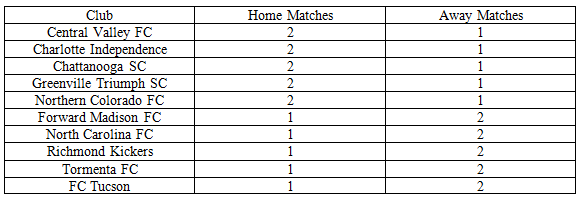
One of the features of having each club play three matches against the other clubs in the league is the inevitable imbalance between home and away matches.  Here is how Union Omaha’s schedule against each club breaks down:

Here’s the good, the bad, and the ugly surrounding the 2022 Union Omaha regular season schedule:

The Good:

  • The club gets plenty of rest at the beginning of the season, allowing the team an easier transition back into the league’s competitive schedule.
  • As the regular season comes to a close, the team begins to have more home matches than away matches.
  • There’s no point in the schedule where the team plays more than two away matches in a row, unlike last season’s streak of six away matches at the beginning of the season.
  • Aside from having two home matches against every new club competing in the league this coming season, the two highest-finishing clubs (outside of Union Omaha) from last season (Greenville Triumph and Chattanooga) will also make multiple visits to Werner Park.
  • Union Omaha has six midweek matches, but four of them are home matches.  Of the six matches that follow those midweek matches, four of them are also home matches.

The Bad:

  • The months of April and June will see fans filling Werner Park only once during each month.
  • June and July each have a small stretch of tough matches.  June has Union Omaha at Chattanooga, at FC Tucson, and finishing up at home against Greenville.  July features a home match against FC Tucson, trips to Greenville Triumph and Forward Madison, and then a home match against Chattanooga.
  • There are only two midweek matches that feature Union Omaha playing on the road and both of those matches are against opponents that are probably the easiest for Union Omaha fans to drive to.

The Ugly:

  • It’s already been stated that the last third of Union Omaha’s regular season will be brutal, but not just because of the condensed scheduling.  From Week 22 to Week 25, Union Omaha will play at Richmond Kickers, host Forward Madison, host Chattanooga, at FC Tucson, host Richmond Kickers, and host Greenville Triumph.  This could end up being the toughest stretch of matches in their season.  In those 21 days, Union Omaha will face a tight schedule of six matches, filled mostly with clubs that played in the 2021 playoffs.  Having an average of 3.5 days of rest before the next opponent will be extremely tough on the Owls.

Now that the 2022 USL League One regular season schedule has been released, you can start to make your travel plans.  The club has repeatedly said how impressed and ingratiated they are by the support of Búhos Nation, so make sure you have your tickets lined up, as well.  Starting in April, the Owls will return to the field to defend their title and the competition is only going to get better.  Even though we’re still in the offseason, Who Gives A Hoot still has you covered for all of the great Union Omaha coverage.  Make sure to continue following us on social media, checking for new articles, and listening to the latest and greatest episodes of the podcast.  We here at Who Gives A Hoot wish you all the safety, comfort, and happiness during the holiday season.  ¡Viva Búhos!

Union Omaha Sees 5 Returnees

            It’s hard to imagine the holiday season bringing any more happiness, but as usual, Union Omaha found a way to give their fans a quality gift: a roster update!

            Yesterday, Union Omaha sent a tweet with a link to the club’s website, announcing the return of five players from the Championship-winning team.  This press release is the first update of any roster signings since the 2021 USL League One Championship.  Fans can begin to celebrate the return of familiar faces while continuing to speculate about their teammates, as well as any players that saw their stock rise after the Open Tryouts.  Either way, the 2022 Union Omaha roster is beginning to take shape and some excellent players are sticking around the Omaha area.

            The first player mentioned in the release is Damià Viader.  If you painted a portrait of Viader using a different color for each accolade, you’d better be prepared for a very colorful portrait.  He was named USL League One Championship MVP, Defender of the Year, and First Team All-League Defender, to name a few.  He showcased his talents at left back and left midfielder, leaving no doubt to his domination along the way.  His return to club next season is a big step toward Union Omaha having another strong season.

            Joining Viader will be Conor Doyle, an integral part of Union Omaha’s offense.  Doyle was no stranger to awards, having been named among “Team of the Week” twice throughout the 2021 USL League One regular season.  While playing in all 30 of Union Omaha’s 2021 matches, he was able to amass six assists.  Even though this past season was his first with the club, manager Jay Mims trusted him by giving him the second-highest amount of minutes played by any Owl on the roster.  Doyle’s intelligence on the field will certainly be of great value next season.

            JP Scearce is another familiar name to many Union Omaha fans.  He’ll be keeping his talents in Werner Park for the 2022 season.  [Editors note: JP was one of two players (Dami is the other) who were already under contract for the season.] During the 2021 season, Scearce was a passing, shooting, and tackling machine.  His defensive efforts lead the team with the most tackles, most tackles won, most duels, most duels won, most aerial duels, and most aerial duels won.  Union Omaha will be more than happy to utilize his talents and work ethic.

            If you’re looking for more defense, then you’ll be happy to know that Daltyn Knutson is returning to the club next season, as well.  Playing as one of the defensive stalwarts in front of the goal, Knutson lead the team in clearances and blocks in 2021.  His presence on the backline was a key factor to Union Omaha’s defensive success.  His calmness in the face of chaos will be welcome returning sight for the club.

            One player we didn’t see a lot of last season, but could easily see a lot more of in 2022 is Kevin Piedrahita.  In his four starts throughout the 2021 season, Piedrahita saved seven shots.  The 2021 season was his first with the club, joining the Owls after leaving CD La Equidad, a first-division club from Colombia.  His experience at top-level soccer will surely help him in the 2022 season.

            There are still plenty of roster announcements to come in the near future, so keep an eye out for more updates from the crew here at Who Gives A Hoot Media.  We’ll continue to bring you updates, analysis, and fun episodes of our podcast.  The 2022 roster is already looking good with these five players, so while you’re waiting for more news, make sure to let these players know how happy you are to see them return.  ¡Viva Búhos!

2021 Awards Recap

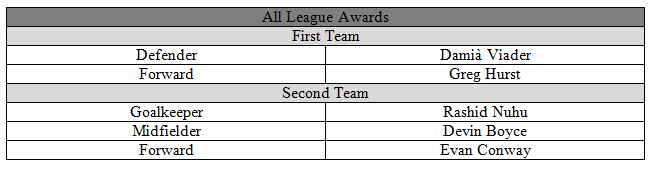
What a season!  The Owls were able to win “the double” and Union Omaha fans can ride that joy for the entire offseason.  There are plenty of team achievements that have been mentioned all season, so let’s break out the microscope, sift through the USL League One awards, and check out the individual awards won by Union Omaha players.

Starting with the man at the helm, Jay Mims won Coach of the Year.  There were lofty expectations around the club and he didn’t shy away from managing his team to another season-long repeat performance of excellence.  He was able to inspire his team to score the most goals in the league this season, concede the fewest, and tie the record for greatest goal differential in a single season. 

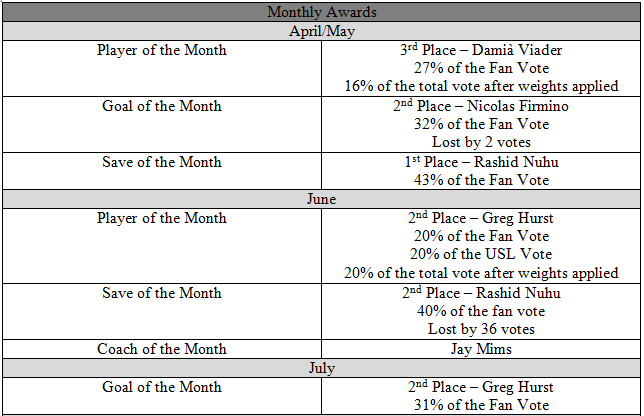
It didn’t take long for Mims to start collecting accolades this season.  He was chosen as the Coach of the Month back in June.  This was due, in part, to the strong start from the Owls.  The team was already undefeated in the month of May, but Union Omaha kept the momentum going for the entire month of June, winning three matches and drawing two others.  The team was able to avoid a single loss, score nine goals, only concede five goals, earn a clean sheet along the way, and finish the month of June in the same place they would ultimately finish the season – first place.

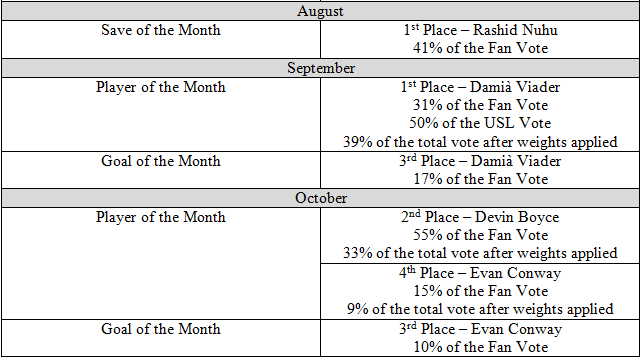
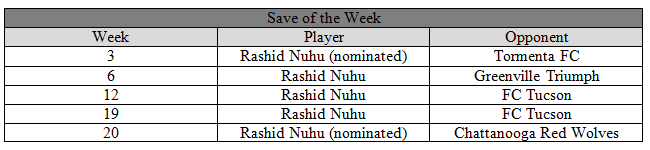
Rashid Nuhu had another stellar year between the goalposts.  By the end of the season, Nuhu was able to boast 0.75 Goal Against Average good enough for the Golden Glove award.  Over the course of his 26 starts this season, the Ghanaian earned nine clean sheets, which was good enough to tie him for second place and only one shutout away from the Goalkeeper of the Year – Akira Fitzgerald.  Rashid Nuhu’s success was consistent and dependable, earning him multiple nominations and recognition in other categories such as a nomination for Save of the Playoffs, Second Team All-League Goalkeeper, two awards for Save of the Month (alongside an additional nomination), three awards for Save of the Week (two extra nominations, as well), and Goalkeeper of the Week on three separate occasions.  Just as his song says, he kept the shots out and in doing so, helped Union Omaha find their way to the podium in November.

Damià Viader was the source of envy for every team in the league.  Jay Mims knew what weapon he had in his arsenal and let him loose.  His punishing play was perfectly balanced with technique and grit, which kept other clubs guessing his next step every minute of the match.  If Viader was disappointed about not winning Most Valuable Player, for which he was deservedly nominated, he had a plethora of awards to keep him company in its absence. 

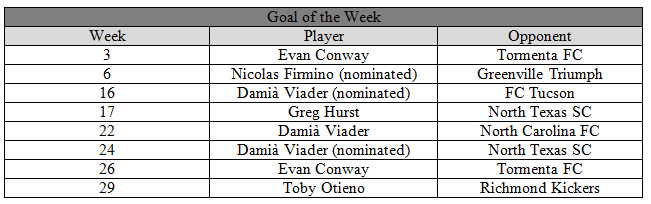
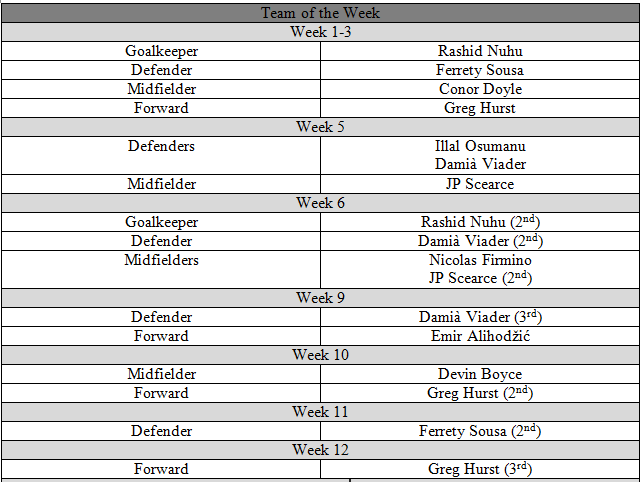
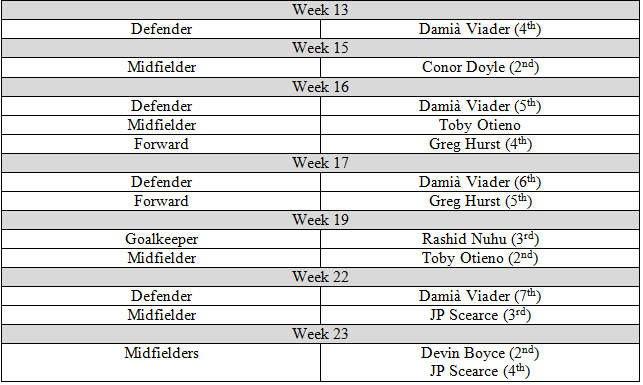
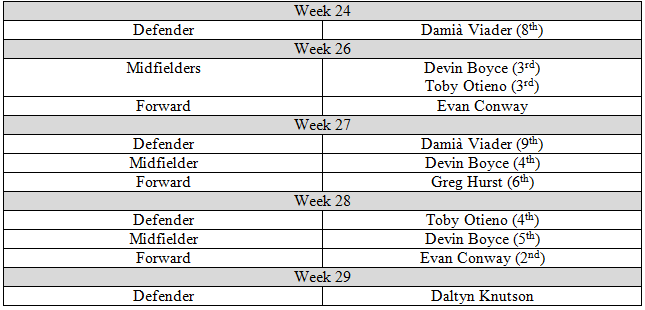
He was awarded Defender of the Year, MVP of the USL League One Championship, First Team All-League Defender, Player of the Month for September (nominated for the same award in one other month), nominated for Goal of the Month in September, awarded Player of the Week in the fifth week of the regular season, winner of Goal of the Week for his goal against North Carolina FC in Week 22 (nominated for two other weeks), and was chosen as a member of the Team of the Week on nine separate weeks.  Viader was one of, if not the, quickest players in the league and he left his competition in the dust literally and figuratively.

Though Greg Hurst came up short in the race for the Golden Boot, he was an essential piece of the offense as Union Omaha dealt with injuries, roster management, and player experimentations in unfamiliar positions.  His unwavering work ethic and high pressure relieved a lot of pressure off his teammates, who returned the kind gesture of feeding him plenty of goal-scoring opportunities. 

At the end of the season, Hurst was recognized as First Team All-League Forward, nominated for Player of the Month in June, nominated for Goal of the Month in July, awarded Player of the Week in Week 10, Goal of the Week in Week 17 (against North Texas SC), and was chosen as a member of Team of the Week six times throughout the regular season.  The Scotsman had incredible chemistry with Evan Conway and was in the highest echelon of players in USL League One for reading the flow of the match and correctly anticipating the next move.

Just because Devin Boyce didn’t win the Assist Champion, doesn’t mean he wasn’t helpful to his teammates.  His work rate, tenacity, and chemistry with Ferrety Sousa was incredible to watch this season.  He didn’t let anyone intimidate him and made sure that only he and Sousa could work the right sideline.  While combining with Sousa, Boyce was often able to get close to the corner flag and send plenty of crosses into the box, which explains why he was tied for second in the race for Assist Champion.  His goal in the USL League One Championship was a masterpiece and was appropriately voted as the Goal of the Playoffs.  He was also recognized as Second Team All-League Midfielder, nominated for Player of the Month in October, and Team of the Week five times (three of which were sequential).  Other players in the league were afraid to turn their lights off at night because, just as his chant suggests, he’s everywhere.

One player who we missed for almost half of the season was Evan Conway.  Union Omaha fans didn’t know it was possible, but they collectively held their breath for nearly three months as Conway was left out of the lineup with an injury.  The 2020 Union Omaha leading scorer didn’t waste any time in making an impact once returning to competition.  Once he returned in Week 20, he more than made for up lost time, finishing the remaining 12 matches in which he played with 8 goals (consisting of two separate hat-tricks) and an assist. 

USL League One fans and voters expressed their love for Conway by nominating him for Goal of the Playoffs, awarded him Second Team All-League Forward, and nominated him for Player of the Month and Goal of the Month in October.  He was awarded Player of the Week twice, Goal of the Week twice, and Team of the Week twice, as well.  As short as his 2021 season was, he left a large impact on the field.  His synergy with Greg Hurst was enough for defenders to start volunteering to be subbed off the field.  A lot of Union Omaha fans are very happy for his recovery, thankful for his contributions, and are already starting to hold their breath again in anticipation of news regarding his contract with the club.

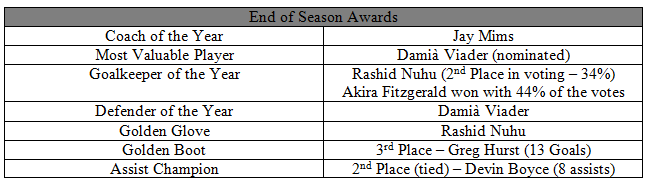
So many players within the club had a huge impact on the season and deserve the recognition they were awarded, or for which they were nominated, this season.  To make life easy for all of you readers, I’ve compiled a complete list of End of Season, Postseason, Monthly, and Weekly nominations and award winners.  Each and every player on the roster worked incredibly hard this season and deserve every bit of support from Búhos Nation.  Once an Owl, Always an Owl.  ¡Viva Búhos!

Ticket Prices around the League plus Season ticket holder events

As a new season quickly approaches and we have all had time to let the high of becoming Champions fade away it is never too early to look ahead to next season and all of the exciting things to come. With season tickets available, and the holidays upon us it is the perfect time to discuss our ticket options and how it compares to the rest of League One, along with some of the possible season ticket holder only events in our future!

When you look at all the options we have available to us its plain to see that prices have gone up since last year. Now that may not be what we all want to hear, but it is inevitable. You don’t win a championship and expect everything to be exactly the same. You’ll be glad to hear though that the pricing model for this year is still extremely good value for the money! 

Let’s talk about value. For an end line seat you’ll be paying under $300 total. If you want the seatback, you pay slightly higher at $285 per seat, or $205 for the berm. Which if you split up into the 16 total matches included you’re only paying $17 and $13 respectively. Where else can you go to get great entertainment for under $20? 

The average movie ticket is $9.37, and popcorn is an astounding $9.09 for a large, and $6.29 for a large soda. $24.75 for one night at the movies which I guarantee if you try to cheer or chant in you’ll be prematurely removed. Fancy dining is much higher as well at around $30. To me the choice is simple. Plus you get to take out some anger by screaming and chanting for 2 hours.

Taking a look at the rest of the league we are comparable to everyone else, who might I add are not reigning champions. Runner up Greenville only has one end line option, which is the supporters section coming in at $150. Which is roughly $10 per match. But who are we kidding, they play in a high school stadium, which lowers the cost of tickets. Love the people, don’t love the stadium option.

Looking at the No Bantz FC, up in Madison their options for end line tickets are on the higher end, and also based on the available information, places them at the top of pricing for this next year. Sitting at a whopping $324 for supporters’ end tickets that places their price per match option at $20.25 per match, yet is still cheaper than a movie or a fancy dinner. You only have to worry about which of the nine kits they are going to wear that day, and if they’re going to switch at half.

Next stop in our theoretical road trip is The Kickers of Richmond. Slightly less than our previous team, they come in at $150 per season ticket. And includes 15 matches, making my job easy by taking my weakest subject in high school out of the equation, at $10 per match you’re sure to get your money’s worth, even if you have to watch The Kickers play in a recycled Arsenal Kit.

North Carolina FC is next up in our list. That is if all of their players finished their chores at home to be able to play in the match. Season tickets come in at $140 for the end line, non supporters section, and $168 for supporters as of last year. Current information is not available at this time. Making them contenders for the top spot for once, in a complete reversal from the table standings. Setting the bar high at $9.30 per match.

Moving on to Tennessee and the Red Wolves of Chattanooga. $126 for end seats and $154 for supporter sections. Beating NCFC for the top spot in value. Coming in at $8.40 per ticket! That’s great value. The only downside being if you’re prone to heart issues this may not be the team for you as they seem to only be able to score in stoppage time. One cool addition is the ability to take unused match tickets and roll them over to another match. So, if you can’t attend one week you can get two tickets to the next week, one perk that should be adopted by more teams in the League. [Editor’s note: *cough* Union Omaha *cough*]

The last team on the East Coast is League One newcomers Charlotte Independence. Giving you all 15 League One matches and 6 W League matches this also has pretty decent value. $99 for supporters end tickets and $180 for end line, this is the cheapest option in the League. We all know there are behind the scenes issues which I won’t discuss here, but at $6.60 per match, nobody can say that the seats aren’t cheap.

Northern Colorado is another new face here. However, there is no information on season tickets as of yet. Which is disappointing. Almost as disappointing as finding out there is no easy way to take a train out there for a match from Omaha. And that drive through western Nebraska is not fun.

Central Valley Fuego was also without season ticket information. I sent in a request and received no word as of this article. Really not much else to say about it, I was in California once, I hated it, Death Valley is a cool place to be for a day, not a month like I was. It gets cold when you’re sleeping on a cot next to a HMMWV in the sand.

Speaking of sand, FC Tucson is up. $150 will get you into the supporters section all season long. Pretty much in line with the rest of USL-1. Bright side of being at a Tucson match though is that you have a high chance of being on TV, and the soccer is pretty good too.

Finally, saving the best value for last heading over to South Georgia Tormenta, their stadium will be going through renovations during this next season so they have only two options for their season tickets. A premium seat, which is next to the GA area, and a General Admission stand. The general admission stand comes in at $160, but does include League One, Two and W league matches. If you attend all the matches from the three Leagues that puts the value at $3.50 per match. A great value for the money to be sure, even if you have to worry about getting a nail in your tire.

I reached out to Supporters Groups around the league, only receiving two answers back. They were both very happy with ticket prices as they are. They are also extremely excited about season ticket holder events returning this year. While no specifics were available at the time they were all optimistic about the possibilities. These events really do mean the world to a lot of fans, it’s nice to have your club do things for the season ticket holders. It really makes you feel like part of the organization.

So as you can see USL-1 teams are all great value for the money you are shelling out every year. All of which include a gift, (usually a scarf) and season ticket holder only events are starting back up now, which is great for everyone involved in this sport. It gives us a chance to meet everyone and do something really cool in the process. I know I’ll be there getting autographs, even if the players are 10+ years younger than me.

Season ticket holders really do become a family. I look forward to seeing the people I sit with every week, learning about them and their family. The fact that we get to watch silverware caliber play is just a bonus. I remember all of their names and can not wait to reconnect with them as soon as we get back to the park. First match back I’ll probably buy my whole row a beer (or soda if my seat neighbor brings his grandkids again). So, here’s hoping that $2 beer before the match returns next year, but even if it isn’t I’d be happy to share the time with my second family.

Greenville Gaffer Gambles, Loses

If you’ve paid attention to soccer in the United States, it’s virtually guaranteed that you’ve heard the name John Harkes tossed around at some point.  His many notable achievements include: first American to play in the English Premier League, won two MLS Cups with D.C. United, and was a routine inclusion to the US Men’s National Team, even captaining the squad for a time.  Since hanging up his cleats [editors note: and mercifully leaving ESPN], Harkes has landed various leadership roles with clubs like D.C. United, New York Red Bulls, FC Cincinnati, and now Greenville Triumph.  There’s no doubt that he belongs in the US Soccer Hall of Fame, but even holding that status can’t protect him from criticism directed at him after the USL League One Championship.

The Greenville Triumph has managed to play in the USL League One Championship every year since the inaugural year in 2019.  In each of those championships, John Harkes was the man tapped to lead the team to victory.  Of the two championships that actually played to a full conclusion, Harkes and co. lost both.  While I can’t speak to what happened in 2019, the more I watched of the 2021 USL League One Championship, the more questions I had.  Join me below as I dive deep into some of the formations and tactics utilized by Greenville Triumph this season.  Before we do, let’s make one clear: the Greenville players deserve to be applauded, as they stuck to the game plan that Harkes planned for the championship.  It would be too reductive to say that the players lost the match.  Sure, the players had their fair share of mistakes, but all in all, John Harkes put forth a game plan that was destined to fail and did little in the way of in-game adjustments to attempt righting the ship.

Let’s start with the first issue of John Harkes’s game plan: the formation.  He chose to start the match in a 4-2-3-1.  If that number sequence doesn’t make sense, it means there were four defenders, two defensive midfielders, three attacking midfielders, and a lone striker up top.

This is a formation that has been used for a few decades, but really started to experience success when it was utilized by the Spanish Men’s National Team, German Men’s National Team, Arsenal in the Premier League, Barcelona and Real Madrid in La Liga, and Bayern Munich in the Bundesliga.  Some of the benefits of the formation, heralded by soccer tacticians, include:

  • Symmetry up and down the field, allowing almost continuous pressure all over the field.
  • Additional attacking options when on offense, especially with the advancing outside backs.
  • Plenty of passing options since the formation is full of passing triangles all over the field.
  • Ability to pressure the opposition high, absorb attacks early.
  • Create a man-up advantage in the middle of the field, flushing opposing attacks to the outside.
  • Easier to repel passes and crosses into the middle of the field.
  • Easier to maintain possession because of all of the options available.

These are some of the effects of a well-oiled 4-2-3-1, but what we saw from Greenville was not a strict and disciplined formation.  As the championship progressed, I started to see how players were pulled out of position and leaving their assignments.  The formation started as a 4-2-3-1 on defense, but morphed into a 3-2-4-1 on offense.  If you’re familiar with the tactics associated with the formation, you might be thinking this is due to the “double pivot” feature of the formation, which allows one of the defensive midfielders to push forward and help with attacks, but the remaining defensive midfielder continued to position himself on the side he originally lined up in and didn’t shift to occupy the middle of the field.  This created an off-balanced defense because one of the center backs would have to occupy that forward space, instead of minding the sides of the field, which is more commonly associated with the center backs as the defensive midfielder shifts to the center.

Another aspect of Greenville’s 4-2-3-1 that was a bit confusing related to their spacing.  Teams lining up in a 4-2-3-1 often look to keep their spacing compact.  By overloading the middle of the field with players, the opposition is forced to divert their attack to the outside, which plays right into the defensive shift of the formation and gives them the greatest chance of closing off attack routes.  Greenville didn’t do this.  The backline didn’t push up the field quickly on offense, the defensive midfielders didn’t shift properly or at the right time, the attacking midfielders played back too far and left Marios Lomis alone up top.

When the defensive midfielders tried to execute the “double pivot” feature of the formation, one of them would push up the field while the team was playing defense.  Yes, you’re pushing an extra man up the field, but giving up plenty of space behind him.  The pivot is usually executed while the team is on offense, adding an extra man to the attack, and creating further instability to the opposing defense.  The timing wasn’t executed correctly, but this will be addressed later in the piece.

The spacing issue can be applied to Greenville’s offense, as well.  Most of the possessions gained in the first half were immediately given away because they would try to send a long ball up the field.  Whether the design was to merely clear the ball away from the defensive third or to streamline the offense and immediately feed the ball to Marios Lomis, it was never clear.  Most of the attempts to find Lomis up top were unsuccessful because he had no support and had to work against the entire Union Omaha backline.  Possessions in a 4-2-3-1 can be quick and can be streamlined, but the team has to move as a unit.  All season long, Greenville opted to move up the field together, pushing numbers up the field, and finding passing windows.  This didn’t happen for the Triumph until later in the match.  Their own source of respite turned out to be their worst enemy that night.

With individual responsibilities not being executed properly, you start to see a lot of the weaknesses involved with a 4-2-3-1 formation, which include:

  • Large areas of space along the sidelines and corners open up due to attacking midfielders and advancing outside backs not tracking back to help on defense.
  • Defense becoming outnumbered by the opposition if the attacking midfielders and advancing outside backs don’t get back and support the back line.
  • The lone striker being left on an island up top because the defense shifts into a 4-5-1 setup with too much space between the midfielders and the striker.
  • Lack of options on offense if the striker doesn’t hold up the play and wait for the attacking midfielders to advance up the field to provide support.
  • Again, if the lone striker is not supported, the opposing defense isn’t stressed enough and can easily outnumber and overpower the striker.

The second issue with John Harkes’s game plan: personnel.  A 4-2-3-1 is a very risky formation to utilize if you don’t have the right players and don’t have the time to adequately train the squad for their individual responsibilities.  Judging from the performances during the championship, Harkes didn’t have the right personnel and either didn’t recognize it, had too much confidence in his players, didn’t spend enough time training the players on their expectations, or was dead-set on using the formation regardless of his roster choices.  I’m going to give Harkes the benefit of the doubt and assume the last few weeks of the season was not enough for his players to fully grasp the concept of the chosen formation.

Why did I specify the last few weeks of the season as not being enough for his players?  If you include the semifinal and championship matches, the club started their last ten matches of the season with a different formation then the previous week on five occasions.  John Harkes was already battling load management and recovery protocols with his often-injured squad, but to throw the players into different schemes five times in the last ten matches is a tough demand on the players.  With every formation change, individual responsibilities change greatly, especially when you start to employ the 4-2-3-1.

I will concede that it is entirely acceptable for a coach to adjust his formation and tactics, depending on who the club is playing next and what the roster affords the coach, but think about this: if you take into account Greenville’s entire season, John Harkes changed the formation 16 times.  Furthermore, from Week 15 to Week 18, the Triumph changed their formation every week and managed to gain two points out of a possible twelve.  With a revolving door of player availability, there simply wasn’t enough time for the players to get a full grasp of their individual responsibilities and establish chemistry with the players around them.

By Week 16 of Greenville’s season, the club had experienced injuries across 14 of their 20 players.  In the toughest run of matches for Greenville, the ten matches between Week 13 and Week 22, the club changed formation in seven of the ten matches, utilizing six entirely different formations, and only succeeded in gaining nine points.  As the team entered Week 13 in second place, they are very fortunate that they only fell to third place at the end of Week 22.  Granted, they were seven points behind Chattanooga at that point and the Red Wolves had a game in hand, as well.  Nonetheless, for a club looking for some sense of stability within their roster, they sure didn’t seem to mind throwing the gauntlet at them once they were available.

In the last ten matches of the season, once again including the semifinal and championship, the 4-2-3-1 was only utilized three times, twice in the last two weeks.  That means after the club played in a 4-2-3-1 against Chattanooga on September 11th, the team wouldn’t line up in that formation again until November 13th – 60 days later.  Even after closing out the regular season against North Carolina FC, John Harkes still planned on the team re-learning their roles in the two weeks between the end of the regular season and the semifinal match against familiar foe Chattanooga.  When it came time to plan for both Chattanooga and Union Omaha, Harkes decided to insert midfielder Noah Pilato into the center attacking midfielder (CAM) position of the 4-2-3-1.  This decision brought on the next batch of issues for Harkes and the Triumph.

There’s no denying that Noah Pilato was a valuable member of the squad during the 2020 season, but his 2021 season was drastically different.  After playing in four of the Triumph’s first six matches, Pilato suffered a back injury that would keep him out of the lineup for most of the 2021 season.  The last match he played in before routinely finding himself on the injury report was Week 10.  Pilato wouldn’t be considered a full participant in training until Week 28.  The first minutes of play given to him since Week 10 would come in Week 29, where he only played four minutes.  The very next week, Week 30, Pilato was back on the bench and didn’t see any minutes.  From his full return to training in Week 28 to the semifinal match, 4 weeks later, Pilato only played four minutes.  Here’s another wrinkle into the system: Noah Pilato had never played the CAM position this season.

Of the four matches Noah Pilato played at the beginning of the season, only one of them consisted of Greenville using the 4-2-3-1 formation.  In that singular match, Pilato started at right defensive midfielder, working alongside Aaron Walker.  Looking back at the seven times that the Triumph used the formation during the regular season, the CAM position was filled by four players.  Forward Don Smart occupied that position the most, playing four matches in the role.  Since Smart hadn’t been featured on the injury reserves since Week 14, it’s a bit puzzling to think why John Harkes would favor Pilato over Smart.

This is where I find the most fault with John Harkes and his decision-making.  Honestly, Noah Pilato wasn’t ready to play in the central attacking midfielder role.  I’m not even sure that he was ready to play a full 90 minutes in a high-pressure match like the championship.  The CAM is a vital piece of the formation, requiring someone to constantly be moving and pressing, someone who can win challenges reliably, someone who can show creativity on offense, and someone who makes sound decisions on offense.  Noah Pilato was none of those the night of the championship.  He was often pulled out of position, didn’t recover that ground, didn’t make an impact on offense, and didn’t show any real desire change the flow of the match.  This goes against everything that should happen with the CAM.  He needed to stay in the middle more, slip behind Union Omaha’s midfield line, act as the creative force on offense, act as a linking source between the defense and offense, and challenge the backline more.

The attacking midfielders in a 4-2-3-1, especially the CAM, are vital to the success of the team.  There are so many individual responsibilities placed on the CAM, which explains why some of the best players in the world play this position with their club.  While the striker may apply pressure up top, they most likely will act more like a shepherd, allowing the attacking midfielders to shift and close off any potential progress up the field.  While watching Greenville play, striker Marios Lomis was working to apply pressure, but Pilato was taking a more defensively-minded position by sitting back closer to the midline, sometimes sitting in his own half.  Defensive midfielder Aaron Walker repeatedly pushed high up with the attacking midfielders to help apply pressure, but in doing so only compromised the team’s defensive structure farther down the field.  When playing a 4-2-3-1, the team has to press high and turn that pressure into their offense.  The defense almost becomes a form of their offense.  If the team is able to force an early turnover, they can outnumber the defense, and turn a fast break into a genuine opportunity on goal.  By applying the defensive pressure of a 4-4-2 central midfielder, which is what Pilato played most as before his injury, he was dooming his team’s chances at applying the right amount of pressure immediately after losing the ball.

If you read the championship recap, you saw that I mentioned how Greenville didn’t get their first shot of the match until the 19th minute.  Leading up to that, Union Omaha had their foot on the gas and weren’t letting up.  John Harkes needed to make adjustments and simply didn’t do so.  He should’ve recognized how Union Omaha was routinely able to get around the attacking midfielders, successfully get by the outside backs, and continuously put pressure on Paul Christensen in goal.  All season long, Union Omaha lived along the sidelines and fed crosses into the box.  The Owls showed capabilities of taking players one-on-one, attacking space, and developing attacks quickly and efficiently, yet John Harkes still formulated a game plan which actually played to Union Omaha’s strengths.  After seeing the first 20 minutes of the match, at the very latest, he needed to be changing tactics from the sideline.  His club was down 0-1 in the seventh minute and his opposition showed no signs of quitting.  Harkes needed to turn to his strengths in the midfield.

Aaron Walker and Max Hemmings are both good central midfielders and belong in a 4-4-2.  They’re aggressive, assertive, confident with the ball, work well together, and have the ability to make intelligent moves on the field.  They played as well as they could in the team’s formation during the championship, but weren’t allowed to show their true potential because their role was limited in the game plan.  The duo was still impactful when needed because, frankly, Noah Pilato was often absent from gameplay throughout the entire match, forcing them out of their position.  These two players were the firefighters for their team, racing across the field to put out fires, recovering time and space given up by teammates, and doing their best to absorb the attack.  This led them, and many other defenders, to be caught over-committing and biting the simple bait from Union Omaha players.

Even in the second half, Greenville showed only a few adjustments.  Their offense was still predictable more often than not.  Their wingers, the outside attacking midfielders, would run straight-line routes up and down the field while on offense.  While the outside backs were able to advance up the field more often on offense, every single one of their routes was forced to the middle of the field.  The winger and the outside back could have shown more creativity by alternating their routes inside and making Union Omaha think a little more on defense.  The Owls sat back into a more defensive shape in the second half, which allowed Greenville to attack more, but they weren’t able to generate high-quality chances on goal because they weren’t able to transfer the offense from sideline to sideline, let alone create access points in the middle of the field.  It was a tough night for Greenville and they did the best with the game plan they were given.

It was a tough season for Greenville.  The played a lot of matches in a condensed amount of time at various points of the regular season, dealt with way too many injuries, and yet still found it in their fighting spirit to make the epic comeback at the tail-end of the season.  Teams that are able to do this find a way to achieve greatness. While the Triumph didn’t win the championship, what this team was able to accomplish was incredible, considering the seemingly insurmountable odds stacked against them.  The players deserve full credit for battling to the very end.  The game plan for the championship didn’t do them justice.  I’m sure the Triumph will be at, or near, the top of the league again next season.  If they’re that good when they’re injured, everyone in the league needs to watch out for them when they’re completely healthy.

As for the fans of the Triumph, they deserve a lot of credit for sticking with their club through thick and thin.  There were plenty of tough times this season, but they hung in there and continued showing up for their club.  Maybe next season the club will break away from their role as Sisyphus – accomplishing greatness by pushing the boulder up the hill during the regular season, only to see it roll back down the hill during the championship.  The fans deserve to see their club win the trophy outright.

2021 League One Champions!

It still seems surreal: Union Omaha won the 2021 USL League One Championship.  Even after 16 days of being able to process everything that happened that wondrous Saturday, new memories still find their way to the surface.  New memories equal new smiles and another surge of pride for Union Omaha.  The players and coaching staff left no doubt as to who deserved to lift the USL League One trophy, as well as the Big Green Belt.  Before we start to report on player contracts, possible coaching changes, and what to expect from the club in the coming season, let’s take another look back at the Championship match between Union Omaha and Greenville Triumph.

Union Omaha showed zero changes to their team formation and personnel.  The team kept their 4-4-2 shape and opted to start the same lineup as they did against FC Tucson in the semifinal a week prior. [Editor’s note: probably a smart choice.] Greenville decided to keep the same shape from their semifinal match against Chattanooga (4-2-3-1), but was forced to make a lone change to their starting eleven as a result of Lachlan McLean suffering an injury.  Prior to the Championship, the Australian striker made 15 appearances, with 10 of those being a starter.  In lieu of McLean’s injury, Greenville’s manager, John Harkes, brought on Jesús Ibarra to start as the right attacking midfielder.  Ibarra would be given the daunting task of battling Union Omaha’s left side of the field, comprised of high-quality players like forward Greg Hurst, midfielders JP Scearce, Conor Doyle, Damià Viader, and defenders Jake Crull, Daltyn Knutson, and Illal Osumanu.

In Union Omaha’s first attack, team captain and defender Ferrety Sousa received a pass from teammate Illal Osumanu inside of Union Omaha’s own half.  After dribbling past the center line, Greenville’s Aaron Walker was able to gradually apply pressure, buy time for the defense to get set up, and shut down a lane toward the center of the field.  Sousa had midfielder Devin Boyce on the right side of the field, but even he was well marked by Greenville defender Tyler Polak.  Sousa’s best option was to slow down the attack and look for an open man, which in this case involved a drop to midfielder JP Scearce.  While standing on the center line, Scearce took one touch to lob the ball up the field to forward Greg Hurst, who was standing about five yards outside of Greenville’s penalty area.  As soon as Hurst controlled the ball, he was double-teamed by Greenville players Evan Lee and Tyler Polak, who left Devin Boyce alone on the side of the field to apply the added pressure.  Hurst was able to split the defenders, cut his way toward the center of the field, deke Max Hemmings easily, and open up a window from which he took a shot on goal.  Greenville’s goalkeeper, Paul Christensen, did a good job of filling the window and limiting Hurst’s angles on the goal.  Despite the fact that Hurst was able to send in a low, powerful shot on goal, Christensen was able to position himself for the easy save.

With Union Omaha’s early pressure on Greenville’s goal, the Triumph seemed to be in desperation mode on defense.  With every possession gained, they often worked too hard and too fast to move the ball up the field to forward Marios Lomis.  With all of the numbers coming back on defense, Greenville wasn’t able to provide enough support for Lomis up top and lot of their long passes resulted in a turnover and renewed offensive opportunities for the Owls.  The next video is an example of this.

Greenville’s right attacking midfielder, Jesús Ibarra, pushed up the field in an attempt to facilitate some connection between the defense and forward Marios Lomis.  When an awkward ball was played to Ibarra, an even more awkward ball was attempted toward Lomis.  Union Omaha defender Daltyn Knutson collected Ibarra’s poor passing attempt and one-touched the ball back toward Greenville’s goal line.  This was a smart move because it prevented Greenville from resetting their defense, allowed Union Omaha renewed opportunities on offense, and kept Greenville’s defense guessing as to how Union Omaha would generate their next attack. 

Knutson’s pass toward the goal line created a physical exchange between Greenville’s Abdi Mohamed and Union Omaha’s Evan Conway.  Mohamed did a good job of shielding the ball, but not good enough, as Conway was able to slip around Mohamed’s right hip, swing his left foot at the ball, and keep it inbounds.  While Mohamed and Conway were left rolling on the field beyond the goal line, Damià Viader took advantage of the given time and freedom to collect the ball. 

No defender applied any pressure to Viader until he dribbled the ball into Greenville’s penalty area.  At that point, Brandon Fricke attempted to cushion his advancements.  Devin Boyce was open near the top of the penalty area, but that opportunity passed quickly because Max Hemmings shifted to the left at the same time as Aaron Walker arriving into his own box for additional defensive support.  Seeing that Boyce was no longer a viable option, Viader made a couple of moves at Fricke, finishing off with a nice cut toward the goal line. 

Fricke set his hips to try to usher Viader away from the goal line, but gave too much space to Viader, who worked against Fricke’s hips and left him scrambling to recover.  There were too many white jerseys filling the goal area, so Viader’s best option was to take a shot on goal. 

From just about six yards away from the goal, Viader’s shot glanced off the crossbar and out of bounds for a Greenville goal kick.  Within the first six minutes of the match, Union Omaha had already generated two high-threatening chances on goal, while Greenville had barely even stepped into Union Omaha’s half.  If Greenville was going to make any defensive adjustments, this was the time to do it.  They didn’t and they were punished for it a minute later.

In the seventh minute, Greenville defender Abdi Mohamed picked up a loose ball after Greg Hurst couldn’t control it.  Almost instantaneously, Union Omaha midfielder Conor Doyle was there to challenge Mohamed a force a turnover.  Doyle’s next touch was a leading pass to Damià Viader on the outside. 

In another matchup with Brandon Fricke, Viader was able to shake him off, only this time he relied on his explosive speed.  Fricke tried a slide tackle in an effort to take away any ground passes into the penalty area.  Unfortunately for Fricke, Viader was able to lift his lob over Fricke’s leg, get it the back post, and give Evan Conway an easy header to open the score line. 

If you look closely at the video, before Viader gets his cross off, there were six Greenville players on Viader’s side of the penalty spot.  Also, as you follow Greg Hurst making his run, you can actually see him watching Devin Boyce make his decision to run toward the front edge of the goal area.  Seeing Boyce’s run and how defenders were shifting to pick him up, Hurst decided to run to the middle of the goal area, with a last-second angle toward the front goal post. 

Even Hurst’s presence in the goal area alerts the defense and continues to shift them away from the back post, where Conway showed incredible discipline to stay where he was.  Paul Christensen may have been able to turn and have a chance at diving toward the ball, but his own defender, Tyler Polak, was standing in his path, leaving him unable to make an aerial dive toward the back post.  It wouldn’t have mattered: the buildup was too quick and Conway placed the header such that a save was out of the question.

Conceding goals had been a rare event for Greenville.  Prior to the Championship, the last time a team had managed to score a goal on Greenville was all of the way back on September 25th – a road match against Forward Madison.  I won’t give you the homework to figure out how many minutes that amounted for Greenville.  The answer?  646 minutes.  That means a perfect October and six straight clean sheets leading up to the Championship.  Greenville deserves the credit for maintaining that level of defensive effort toward the end of the season and setting themselves up for success in the playoffs.  That being said, this wasn’t the same Greenville Triumph that we’ve all grown accustomed to seeing on a weekly basis.

Inside of 15 minutes, Greenville’s players were still panicking on defense.  When any of the players were able to get a foot on the ball, there was virtually no organization or buildup to their offense.  The players were immediately sending the ball up the field in lame attempts to connect with Marios Lomis.  Because Union Omaha was able to keep their defensive shape, they were able to outnumber Lomis everywhere he went.  Lomis’s touches on the ball were minimal and Greenville’s greatest offensive threat was being eliminated from the match.  This opened the door for more Union Omaha attacks.

In the 15th minute, Union Omaha was maintaining a good, constant effort of applying offensive pressure straight out of their own half.  In the next video, midfielder Conor Doyle saw Devin Boyce in open space and recognized the attacking potential.  As Doyle moved the ball to Boyce, watch as Greenville is able to get numbers back behind the ball.  Their defenders are constantly turning their heads, tracking Union Omaha players, and communicating. 

Despite Greenville getting their defense set up, Union Omaha was still able advance up the field because they utilized their passing triangles along the outside and paired that tactic with some good one-touch passing.  After Sousa loses the ball, a Greenville defender executes another poor clearance from the goal line and the ball falls right to Union Omaha’s JP Scearce. 

Rather than settling the ball, Scearce made the good decision to head the ball directly back into the offensive third and keep that offensive flame roaring.  Scearce’s header fell to the feet of Hurst, who fed a lateral pass along the top of the penalty area for Evan Conway to take a shot.  Conway would’ve loved to have that shot back, but this was another case of Union Omaha being proactive and Greenville being reactionary.  The Triumph weren’t being given time to set up their defense, or to take a collective breath while the offense tried to generate something.

Greenville fans would have to wait until the 19th minute of play before seeing the first shot.  Triumph’s attacking midfielder Noah Pilato took the shot from well outside of the Union Omaha penalty area and was blocked by defender Daltyn Knutson.  Union Omaha goalkeeper Rashid Nuhu was able to pick up the rebound without any high pressure from the Triumph.  It was Greenville’s first chance on offense, but by that time, Union Omaha had already taken five shots, two of which were on target, and tallied a goal.  It was very apparent that the Greenville formation and tactics were not right if they wanted any hope of turning the tide.  This article will provide a general rundown of the Championship footage, but discussion regarding the formation and tactics will come shortly after this article is posted.

The 22nd minute saw Greenville apply more pressure on offense, but similar to the first attempt, the shot wasn’t on target, either.  A huge reason for Greenville lacking on the offensive side was their failure to include striker Marios Lomis.  In the first 25 minutes of the match, Lomis had only touched the ball three times.  Almost half of Greenville’s goals came from the feet of Lomis and to have him looking rather pedestrian early in the Championship did not bode well for the reigning champions.

If you go back and watch a lot of footage from Union Omaha matches, it’s easy to gain more and more of an appreciation for midfielder Conor Doyle and his very intelligent level of play.  Here’s an example of that:

In the 30th minute, Conor Doyle (originally lined up as the left center midfielder) is sitting in the middle of the field, while his partner in the middle of the midfield, JP Scearce, is actually stacked above him.  Greenville’s Noah Pilato floats back to mark up on Scearce and take away the passing option.  When defender Jacob Crull looks to split Pilato and Marios Lomis, there’s too much space between the two Triumph players and they’re unable to intercept the pass.  The ball finds its way to Conor Doyle’s feet and he dribbles the ball toward the center line.  As he does so, Ferrety Sousa remains open on the sideline and is rewarded with the pass. 

The key thing to watch here is how Doyle doesn’t give up on the play.  In fact, he runs through traffic, allowing Sousa to give him an easy pass on the go, and Doyle can then push the ball inside to Devin Boyce before Allen Gavilanes can stab the ball away.  In the blink of an eye, three Greenville players are now scrambling to get back on defense and the corner is wide open.  A simple thru-ball from Boyce to Hurst extends the pressure and gives Doyle extra time to get himself into the corner.  Once Hurst relays the ball to Doyle on the outside, Hurst cuts back into the box and brings the defender with him.  Doyle tries to cross a ball to the center of the box, but Evan Conway was outnumbered by Greenville players and the ball was cleared.  The Triumph were seen over-committing on too many occasions in the first half and Union Omaha was able to generate these kinds of attacks on a seemingly routine basis.

As the second half wore on, especially around the 29th minute, you could start to see confidence building in the Greenville players.  They weren’t unleashing clearances left and right and they weren’t forcing everything up the right side of the field, which combined to allow them more time with the ball and confidence in building up their attacks.

In one of Union Omaha’s true defensive moments, you can see Greenville move up the left side of the field and genuinely start to build an attack.  A good reason for this is left back Tyler Polak moving up the field.  For the first half hour of play, Polak would sit back defiantly and avoid any notion of supporting the offense in transition.  With Polak advancing into Union Omaha’s defensive third, Greenville could begin to move the ball and stretch the space.  Unfortunately for Greenville, as a part of their tactics and formation, the ball was eventually played back toward the middle, where no one was playing at that time.

On the other side of the field, it was business as usual for Union Omaha.  Evan Conway ran into a brick wall in the 42nd minute, but was able to turn himself around and hold up play while more teammates entered the Greenville half.  One of those teammates was Conor Doyle, again gravitating toward the right sideline.  Here’s another example of heads-up play from Doyle:

After receiving the pass from Conway, you can see Doyle lifting his head up and scanning the field.  Once he plays the simple pass to Ferrety Sousa, he decides to sit back.  Why?  Because a little farther up the field is Devin Boyce, who was able to sneak behind two defenders and has space available near the corner flag.  When Sousa decided to pass the ball back to Doyle, he already knew where he wanted to place the ball.  He lobs the ball over the line of defenders, drops it right along the sideline, and Boyce is able to run it down with time to spare. 

After taking a touch, Boyce sends a cross directly into the box to Evan Conway.  It didn’t matter that Greenville had two players near Conway, he was still able to get a head on the ball.  Unfortunately, he couldn’t get the contact he wanted and sent the ball wide.  This was another good build up, good threat on goal, and the Owls were able to remain unpredictable on offense.

Greenville’s defense was constantly bending to Union Omaha’s attacks, so it was only a matter of time before they would break.  That moment would come in the 43rd minute.  Greenville defender Tyler Polak received a return pass from midfielder Max Hemmings and looked to try a one-touch drop pass.  When Polak swung his foot down to kick the ball, he catches a lot more of the turf than the ball and doesn’t generate enough force behind the ball the complete the pass. 

Fortunately for Union Omaha, Greg Hurst was right there to pounce on the loose ball and generate a fast break.  With Triumph players spread out as far as they were, Hurst was gifted plenty of room in the middle.  Defenders were trying to shepherd Hurst toward the sideline, but Hurst was able to find Damià Viader, who cut the ball back toward the middle of the field.  Viader was able to take on Abdi Mohamed and dribbled toward the penalty arc. 

As he came across the box, Tyler Polak was positioned too far toward the middle of the field and Devin Boyce was left wide open on the right side.  While Polak was struggling to close in on the ball, all Boyce had to do was a simple cutback, let Polak’s momentum carry him out of the play, and Boyce suddenly had space inside the penalty area again. 

When Boyce took his shot, he wasn’t able to execute the shot he wanted, but Hurst was there to redeem him for the highlight reel.  In what looked like a bad shot toward the goal, the ball ended up at the feet of Hurst, who stuck a foot out and redirected the ball into the back of the net.  An ugly shot turned into an assist and Union Omaha managed to double their lead right before halftime.

The first-half stats tell the whole story:

Union Omaha had the lead, more shots, more shots on target, didn’t need to rely on possession, and still remained pretty consistent with their passing accuracy in either half of the field.  Greenville, however, didn’t seem to pose a threat in the first half.  Their long passes come from trying to move the ball out of their defensive third as quickly as possible, but once they were finally able to carry the ball across the center line, their offense sputtered.  They didn’t have a quality link or transition from defense to offense and they crumbled as soon as they crossed into their opponents half of the field.

As the second half started, Greenville chose not to make any personnel changes and decided to keep their 4-2-3-1 formation.  There were two other noticeable changes with Greenville: their players were spreading out even more when in possession and their outside backs looked very willing and determined to make their way up the field.  The players were moving the ball with a lot more confidence and worked hard to open up the left side of the field.  In the first half, most of Greenville’s offense was generated on the right side, but they were still able to produce some good possession on the left side just before half, as well. 

The Championship match started to become a chippy affair, especially after Evan Conway’s foul against goalkeeper Paul Christensen in the 50th minute.  This wasn’t mentioned earlier, but Conway did receive a yellow card in the first half.  When Conway was able to split a pair of Greenville defenders, he continued dribbling toward the goal.  Max Hemmings was able to wedge himself between Conway and the ball, allowing Christensen to come off his line and get his hands on the ball.  Conway, attempting to challenge Christensen, stuck his foot out for the ball just after Christensen had already collecting the ball. 

Yes, it was a nearly instantaneous exchange, but you have to remember: Conway is sitting on a yellow card.  Union Omaha may be up 2-0 in the 50th minute, but is challenging that ball really worth the risk of getting a second yellow card, finishing the match in the locker room, and creating a nearly second half-long disadvantage for your teammates?  I don’t think so.  With as much as referees protect goalkeepers, and deservedly so, Conway should not have given the referee any opportunities to award him a second card.  Ultimately, the referee made the difficult, yet right, decision to give Conway a stern warning and continue play.

Only two minutes later, Conor Doyle was approaching Aaron Walker to apologize for a challenge and Abdi Mohamed showed exception to Doyle’s challenge and exchanged pleasantries.  This became a recurring theme as the match drew closer to the end: Greenville would feel the need to file their grievances with lengthy conversations, yet seemed to not care at all about the clock and their dwindling opportunities to even the score. 

Yes, Greenville may have been operating on the basis of influencing the center referee into awarding cards and fouls in their favor, while also trusting the fourth official to maintain accurate notes for extra time at the end of regulation, but why let the result rest in the hands of people other than your teammates?  Get the ball back in play, move it with a sense of purpose, and generate some offense.  Long story, short: they didn’t.

Here’s a moment where Greenville continued to show more confidence with the ball and even maintained possession outside of Union Omaha’s penalty area.  As you watch the following video, look at how condensed the midfield and defensive lines are kept.  The Owls do a good job of shifting and adjusting their responsibilities.  Case in point: Damià Viader was a winger, yet was playing in the middle.  Conor Doyle, who was one of the central midfielders, shifted to the outside.  As the throw-in happens, Doyle is set on the right side of the field, yet finished the play on the left side of the field.  Even Evan Conway was able to apply some pressure.

Since Doyle started on the right side, Viader floated in, but as the ball continued to move from Greenville player to Greenville player, Scearce drifted up to apply pressure, then Viader did the same on the next player.  This movement allowed Doyle time to scan the field, recognize where the players were set, where the ball was likely to go, and get himself into a good position to continue providing valuable defensive coverage.

While the play ended with Union Omaha conceding a foul, the Owls continued to commit small, nagging fouls which disrupted Greenville’s rhythm, possibly taking their focus off of the match as a whole, directing their focus toward the next physical encounter with the rival Union Omaha player, and managed to eat up the clock.  Every time the ref blew the whistle, he had to justify himself to the players, take time to mark off ten yards, and spray the field in both locations.  It simply ate up the clock.  This is just another facet of the gamesmanship involved in soccer, especially toward the end of the match.

Union Omaha fans thought the Owls had tripled the lead in the 70th minute, but the referee disallowed the goal and restarted play correctly.  Union Omaha earned a corner kick and Devin Boyce kicked an out-swinger, which was cleared away by Max Hemmings and Jesús Ibarra, but Damià Viader was able to lob the ball right back into the action, helped further along by a header from Daltyn Knutson.  When Brandon Fricke fails horribly at clearing the ball, Hurst moves in to challenge Paul Christensen on the goal line. 

Before Hurst leaves the ground, he doesn’t quite get his feet set in place to make his jump straight up and down.  He’s perfectly in the right to challenge the keeper, but because he drifted to his right and into the keeper, it was an easy call for the center referee.  It’s not uncommon for keepers to try to give themselves space during an aerial challenge and protect themselves by leading their jump with a knee in the air, but Christensen must have felt threatened enough by Hurst’s challenge to feel the need to jump with two legs, instead of one.

 The yellow card that Evan Conway earned in the first half would finally come into play, but not until the 77th minute.  After the stern warning doled out earlier in the second half, Conway continued to press the issue.  The center referee finally had enough.  When Max Hemmings was dribbling the ball into the Union Omaha half, Conway was hot on his trail and gave the slightest of pushes from behind, sending Hemmings to the ground. 

Sure, it was a silly challenge to award a yellow card, but it wasn’t an isolated incident.  The referee awarded the second yellow card for persistent infringement and Conway was given an early exit from the match.  It was an unnecessary foul, especially with so many teammates already behind the ball.  Conway could have easily continued to shepherd players to the outside and reduced his defensive stance, but that didn’t happen.  [Editor’s note: but don’t you love the pressing/defensive energy he was bringing to the game?!]

Thankfully, the red card was awarded in the 77th minute, instead of the 50th.  Earning a red card, even if it was late in the second half, still put his teammates in a difficult position.  Fortunately for Union Omaha, Greenville was doing well with possessing the ball in the Union Omaha’s half, but couldn’t figure out a way to make Rashid Nuhu nervous.

After the Evan Conway red card, and a couple of Greenville substitutions, the Triumph started to show some quality up-tempo movement from the midfield and striker, but still not enough impetus from the defensive line.  When Alex Morrell and Nico Brown were subbed into the match, they did a very good job of injecting energy into the offense.  In fact, within two minutes of being subbed on in the 82nd minute, they almost combined for a goal.  All in all, Greenville was still guilty of being too willing to drop the ball, possess, and slowly build up their attack.  It really didn’t make too much sense, but maybe the Greenville players had already conceded victory, despite having a man-up advantage for over 20 minutes of play (with extra time included).

Another moment of controversy occurred late in the match, when Greenville was given a corner kick in the first minute of extra time.  The service was perfectly placed at the top of the goal area and Andrew Booth was able to get his head on the ball and direct it at the goal.  Rashid Nuhu was able to catch the ball and immediately went to ground.  While he was on the ground, the ball seemed to be uncontrolled for a quick second and Greenville players and fans have every right to contest the no-call. 

Since USL League One doesn’t employ Video Assistant Referee, the problem lies with where the referees are positioned at the time in question.  The center referee looked to be outside of the penalty area, toward the left side of the middle of the field, and had no way of seeing the ball over the line, let alone rushing into the box in time to see the placement.  Meanwhile, the assistant ref, placed on the opposite sideline of where the corner kick was taken, had the best chance at making the call.  She was obstructed by the goal post, as well as Toby Otieno’s leg.  If she couldn’t make the call with 100% confidence, she made the right call with not awarding a goal to Greenville.

Once the video replay showed a close-up of the situation, even from the angle of the cameras used for the broadcast, the ball looks to have moved across the goal line.  The color commentator for the broadcast, Devon Kerr, used the perfect analogy for what Rashid Nuhu was doing as he was on the ground with the ball: framing the ball much like a catcher does in baseball.  While Nuhu was on the ground, it looked like he was situating the ball such that by the time any referee could get a good look at the ball, it would be on top of the goal line at the very least.  With regards to Toby Otieno’s leg, the fact that he had his leg on the outside of the goal line gave the assistant referee even less of an angle to see.  With his leg along the outside of the goal line, that’s a few more inches obstructed from her vision and more room for error with Nuhu and the ball.  Neither referee could say with absolute certainty that the ball crossed the line, so play had to be continued.  The replay seemed to indicate otherwise, though. [Editor’s note: I’m not as sure the whole ball crossed the whole line. Maybe if they had better cameras…]

Just like the teams battling in extra time, the scoring wasn’t finished, either.  After a throw-in from Emir Alihodžić sailed over three Greenville defenders, Toby Otieno suddenly found himself in a race toward the net with Tyler Polak.  Evan Lee can be seen positioning himself at the top of the goal area, but Toby gets around a frankly terrible display of defending from Lee and buries the ball into the far-post netting.  The second goal may have been the insurance policy, but the third goal was nothing less than the dagger in the heart.  There may have been three minutes left in extra time, but all hope of a comeback was dashed with Otieno’s calm finish.

As if signifying the beginning of the happiest choir performance in Omaha, the final whistle was met with nothing but utmost joy and celebration.  There was no reverie among the players and fans because the reactions were completely instinctive.  It would take several seconds before pleasant memories would begin to form.  This may have been Union Omaha’s second year in existence and second year of eligibility for the Championship, but the wait for professional soccer in this region has been much longer.  Teams formed and those very same teams faded, only to become lore of Nebraska sports.  Among the 5,221 people that made their way to Werner Park that evening, there was a sense of relief.  Union Omaha is here to stay and with it, their greatness.

Congratulations to Union Omaha: the players, the coaching staff, the front office workers, the medical crew, the field crew, and everyone else who had a part in this momentous occasion.  A warm thank you goes out to everyone, past and present, associated with the club.  The devotion and commitment to success goes without saying, but the continued outreach and reverence toward the fans and surrounding community cannot be adequately described through words.  Not even the voices of support, the tifo, the posters, the songs, and the thunderous applause can even remotely express our sincere gratitude for what you, Union Omaha, have given to your fans.  Though the meaning of this championship translates differently from person to person, we can all agree when we say those two simple words: thank you.

¡Viva Búhos!