If you’ve paid attention to soccer in the United States, it’s virtually guaranteed that you’ve heard the name John Harkes tossed around at some point. His many notable achievements include: first American to play in the English Premier League, won two MLS Cups with D.C. United, and was a routine inclusion to the US Men’s National Team, even captaining the squad for a time. Since hanging up his cleats [editors note: and mercifully leaving ESPN], Harkes has landed various leadership roles with clubs like D.C. United, New York Red Bulls, FC Cincinnati, and now Greenville Triumph. There’s no doubt that he belongs in the US Soccer Hall of Fame, but even holding that status can’t protect him from criticism directed at him after the USL League One Championship.
The Greenville Triumph has managed to play in the USL League One Championship every year since the inaugural year in 2019. In each of those championships, John Harkes was the man tapped to lead the team to victory. Of the two championships that actually played to a full conclusion, Harkes and co. lost both. While I can’t speak to what happened in 2019, the more I watched of the 2021 USL League One Championship, the more questions I had. Join me below as I dive deep into some of the formations and tactics utilized by Greenville Triumph this season. Before we do, let’s make one clear: the Greenville players deserve to be applauded, as they stuck to the game plan that Harkes planned for the championship. It would be too reductive to say that the players lost the match. Sure, the players had their fair share of mistakes, but all in all, John Harkes put forth a game plan that was destined to fail and did little in the way of in-game adjustments to attempt righting the ship.
Let’s start with the first issue of John Harkes’s game plan: the formation. He chose to start the match in a 4-2-3-1. If that number sequence doesn’t make sense, it means there were four defenders, two defensive midfielders, three attacking midfielders, and a lone striker up top.
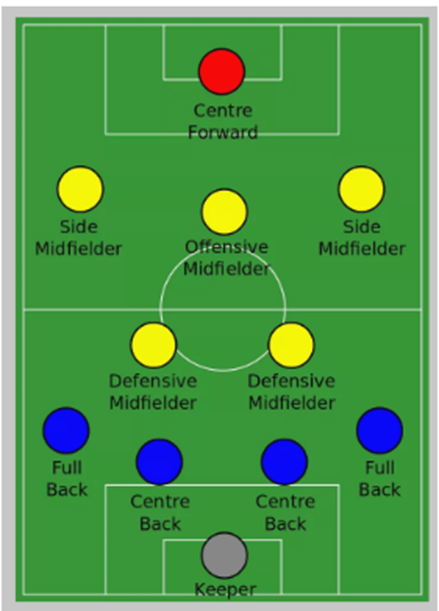
This is a formation that has been used for a few decades, but really started to experience success when it was utilized by the Spanish Men’s National Team, German Men’s National Team, Arsenal in the Premier League, Barcelona and Real Madrid in La Liga, and Bayern Munich in the Bundesliga. Some of the benefits of the formation, heralded by soccer tacticians, include:
- Symmetry up and down the field, allowing almost continuous pressure all over the field.
- Additional attacking options when on offense, especially with the advancing outside backs.
- Plenty of passing options since the formation is full of passing triangles all over the field.
- Ability to pressure the opposition high, absorb attacks early.
- Create a man-up advantage in the middle of the field, flushing opposing attacks to the outside.
- Easier to repel passes and crosses into the middle of the field.
- Easier to maintain possession because of all of the options available.
These are some of the effects of a well-oiled 4-2-3-1, but what we saw from Greenville was not a strict and disciplined formation. As the championship progressed, I started to see how players were pulled out of position and leaving their assignments. The formation started as a 4-2-3-1 on defense, but morphed into a 3-2-4-1 on offense. If you’re familiar with the tactics associated with the formation, you might be thinking this is due to the “double pivot” feature of the formation, which allows one of the defensive midfielders to push forward and help with attacks, but the remaining defensive midfielder continued to position himself on the side he originally lined up in and didn’t shift to occupy the middle of the field. This created an off-balanced defense because one of the center backs would have to occupy that forward space, instead of minding the sides of the field, which is more commonly associated with the center backs as the defensive midfielder shifts to the center.
Another aspect of Greenville’s 4-2-3-1 that was a bit confusing related to their spacing. Teams lining up in a 4-2-3-1 often look to keep their spacing compact. By overloading the middle of the field with players, the opposition is forced to divert their attack to the outside, which plays right into the defensive shift of the formation and gives them the greatest chance of closing off attack routes. Greenville didn’t do this. The backline didn’t push up the field quickly on offense, the defensive midfielders didn’t shift properly or at the right time, the attacking midfielders played back too far and left Marios Lomis alone up top.
When the defensive midfielders tried to execute the “double pivot” feature of the formation, one of them would push up the field while the team was playing defense. Yes, you’re pushing an extra man up the field, but giving up plenty of space behind him. The pivot is usually executed while the team is on offense, adding an extra man to the attack, and creating further instability to the opposing defense. The timing wasn’t executed correctly, but this will be addressed later in the piece.
The spacing issue can be applied to Greenville’s offense, as well. Most of the possessions gained in the first half were immediately given away because they would try to send a long ball up the field. Whether the design was to merely clear the ball away from the defensive third or to streamline the offense and immediately feed the ball to Marios Lomis, it was never clear. Most of the attempts to find Lomis up top were unsuccessful because he had no support and had to work against the entire Union Omaha backline. Possessions in a 4-2-3-1 can be quick and can be streamlined, but the team has to move as a unit. All season long, Greenville opted to move up the field together, pushing numbers up the field, and finding passing windows. This didn’t happen for the Triumph until later in the match. Their own source of respite turned out to be their worst enemy that night.
With individual responsibilities not being executed properly, you start to see a lot of the weaknesses involved with a 4-2-3-1 formation, which include:
- Large areas of space along the sidelines and corners open up due to attacking midfielders and advancing outside backs not tracking back to help on defense.
- Defense becoming outnumbered by the opposition if the attacking midfielders and advancing outside backs don’t get back and support the back line.
- The lone striker being left on an island up top because the defense shifts into a 4-5-1 setup with too much space between the midfielders and the striker.
- Lack of options on offense if the striker doesn’t hold up the play and wait for the attacking midfielders to advance up the field to provide support.
- Again, if the lone striker is not supported, the opposing defense isn’t stressed enough and can easily outnumber and overpower the striker.
The second issue with John Harkes’s game plan: personnel. A 4-2-3-1 is a very risky formation to utilize if you don’t have the right players and don’t have the time to adequately train the squad for their individual responsibilities. Judging from the performances during the championship, Harkes didn’t have the right personnel and either didn’t recognize it, had too much confidence in his players, didn’t spend enough time training the players on their expectations, or was dead-set on using the formation regardless of his roster choices. I’m going to give Harkes the benefit of the doubt and assume the last few weeks of the season was not enough for his players to fully grasp the concept of the chosen formation.
Why did I specify the last few weeks of the season as not being enough for his players? If you include the semifinal and championship matches, the club started their last ten matches of the season with a different formation then the previous week on five occasions. John Harkes was already battling load management and recovery protocols with his often-injured squad, but to throw the players into different schemes five times in the last ten matches is a tough demand on the players. With every formation change, individual responsibilities change greatly, especially when you start to employ the 4-2-3-1.
I will concede that it is entirely acceptable for a coach to adjust his formation and tactics, depending on who the club is playing next and what the roster affords the coach, but think about this: if you take into account Greenville’s entire season, John Harkes changed the formation 16 times. Furthermore, from Week 15 to Week 18, the Triumph changed their formation every week and managed to gain two points out of a possible twelve. With a revolving door of player availability, there simply wasn’t enough time for the players to get a full grasp of their individual responsibilities and establish chemistry with the players around them.
By Week 16 of Greenville’s season, the club had experienced injuries across 14 of their 20 players. In the toughest run of matches for Greenville, the ten matches between Week 13 and Week 22, the club changed formation in seven of the ten matches, utilizing six entirely different formations, and only succeeded in gaining nine points. As the team entered Week 13 in second place, they are very fortunate that they only fell to third place at the end of Week 22. Granted, they were seven points behind Chattanooga at that point and the Red Wolves had a game in hand, as well. Nonetheless, for a club looking for some sense of stability within their roster, they sure didn’t seem to mind throwing the gauntlet at them once they were available.
In the last ten matches of the season, once again including the semifinal and championship, the 4-2-3-1 was only utilized three times, twice in the last two weeks. That means after the club played in a 4-2-3-1 against Chattanooga on September 11th, the team wouldn’t line up in that formation again until November 13th – 60 days later. Even after closing out the regular season against North Carolina FC, John Harkes still planned on the team re-learning their roles in the two weeks between the end of the regular season and the semifinal match against familiar foe Chattanooga. When it came time to plan for both Chattanooga and Union Omaha, Harkes decided to insert midfielder Noah Pilato into the center attacking midfielder (CAM) position of the 4-2-3-1. This decision brought on the next batch of issues for Harkes and the Triumph.
There’s no denying that Noah Pilato was a valuable member of the squad during the 2020 season, but his 2021 season was drastically different. After playing in four of the Triumph’s first six matches, Pilato suffered a back injury that would keep him out of the lineup for most of the 2021 season. The last match he played in before routinely finding himself on the injury report was Week 10. Pilato wouldn’t be considered a full participant in training until Week 28. The first minutes of play given to him since Week 10 would come in Week 29, where he only played four minutes. The very next week, Week 30, Pilato was back on the bench and didn’t see any minutes. From his full return to training in Week 28 to the semifinal match, 4 weeks later, Pilato only played four minutes. Here’s another wrinkle into the system: Noah Pilato had never played the CAM position this season.
Of the four matches Noah Pilato played at the beginning of the season, only one of them consisted of Greenville using the 4-2-3-1 formation. In that singular match, Pilato started at right defensive midfielder, working alongside Aaron Walker. Looking back at the seven times that the Triumph used the formation during the regular season, the CAM position was filled by four players. Forward Don Smart occupied that position the most, playing four matches in the role. Since Smart hadn’t been featured on the injury reserves since Week 14, it’s a bit puzzling to think why John Harkes would favor Pilato over Smart.
This is where I find the most fault with John Harkes and his decision-making. Honestly, Noah Pilato wasn’t ready to play in the central attacking midfielder role. I’m not even sure that he was ready to play a full 90 minutes in a high-pressure match like the championship. The CAM is a vital piece of the formation, requiring someone to constantly be moving and pressing, someone who can win challenges reliably, someone who can show creativity on offense, and someone who makes sound decisions on offense. Noah Pilato was none of those the night of the championship. He was often pulled out of position, didn’t recover that ground, didn’t make an impact on offense, and didn’t show any real desire change the flow of the match. This goes against everything that should happen with the CAM. He needed to stay in the middle more, slip behind Union Omaha’s midfield line, act as the creative force on offense, act as a linking source between the defense and offense, and challenge the backline more.
The attacking midfielders in a 4-2-3-1, especially the CAM, are vital to the success of the team. There are so many individual responsibilities placed on the CAM, which explains why some of the best players in the world play this position with their club. While the striker may apply pressure up top, they most likely will act more like a shepherd, allowing the attacking midfielders to shift and close off any potential progress up the field. While watching Greenville play, striker Marios Lomis was working to apply pressure, but Pilato was taking a more defensively-minded position by sitting back closer to the midline, sometimes sitting in his own half. Defensive midfielder Aaron Walker repeatedly pushed high up with the attacking midfielders to help apply pressure, but in doing so only compromised the team’s defensive structure farther down the field. When playing a 4-2-3-1, the team has to press high and turn that pressure into their offense. The defense almost becomes a form of their offense. If the team is able to force an early turnover, they can outnumber the defense, and turn a fast break into a genuine opportunity on goal. By applying the defensive pressure of a 4-4-2 central midfielder, which is what Pilato played most as before his injury, he was dooming his team’s chances at applying the right amount of pressure immediately after losing the ball.
If you read the championship recap, you saw that I mentioned how Greenville didn’t get their first shot of the match until the 19th minute. Leading up to that, Union Omaha had their foot on the gas and weren’t letting up. John Harkes needed to make adjustments and simply didn’t do so. He should’ve recognized how Union Omaha was routinely able to get around the attacking midfielders, successfully get by the outside backs, and continuously put pressure on Paul Christensen in goal. All season long, Union Omaha lived along the sidelines and fed crosses into the box. The Owls showed capabilities of taking players one-on-one, attacking space, and developing attacks quickly and efficiently, yet John Harkes still formulated a game plan which actually played to Union Omaha’s strengths. After seeing the first 20 minutes of the match, at the very latest, he needed to be changing tactics from the sideline. His club was down 0-1 in the seventh minute and his opposition showed no signs of quitting. Harkes needed to turn to his strengths in the midfield.
Aaron Walker and Max Hemmings are both good central midfielders and belong in a 4-4-2. They’re aggressive, assertive, confident with the ball, work well together, and have the ability to make intelligent moves on the field. They played as well as they could in the team’s formation during the championship, but weren’t allowed to show their true potential because their role was limited in the game plan. The duo was still impactful when needed because, frankly, Noah Pilato was often absent from gameplay throughout the entire match, forcing them out of their position. These two players were the firefighters for their team, racing across the field to put out fires, recovering time and space given up by teammates, and doing their best to absorb the attack. This led them, and many other defenders, to be caught over-committing and biting the simple bait from Union Omaha players.
Even in the second half, Greenville showed only a few adjustments. Their offense was still predictable more often than not. Their wingers, the outside attacking midfielders, would run straight-line routes up and down the field while on offense. While the outside backs were able to advance up the field more often on offense, every single one of their routes was forced to the middle of the field. The winger and the outside back could have shown more creativity by alternating their routes inside and making Union Omaha think a little more on defense. The Owls sat back into a more defensive shape in the second half, which allowed Greenville to attack more, but they weren’t able to generate high-quality chances on goal because they weren’t able to transfer the offense from sideline to sideline, let alone create access points in the middle of the field. It was a tough night for Greenville and they did the best with the game plan they were given.
It was a tough season for Greenville. The played a lot of matches in a condensed amount of time at various points of the regular season, dealt with way too many injuries, and yet still found it in their fighting spirit to make the epic comeback at the tail-end of the season. Teams that are able to do this find a way to achieve greatness. While the Triumph didn’t win the championship, what this team was able to accomplish was incredible, considering the seemingly insurmountable odds stacked against them. The players deserve full credit for battling to the very end. The game plan for the championship didn’t do them justice. I’m sure the Triumph will be at, or near, the top of the league again next season. If they’re that good when they’re injured, everyone in the league needs to watch out for them when they’re completely healthy.
As for the fans of the Triumph, they deserve a lot of credit for sticking with their club through thick and thin. There were plenty of tough times this season, but they hung in there and continued showing up for their club. Maybe next season the club will break away from their role as Sisyphus – accomplishing greatness by pushing the boulder up the hill during the regular season, only to see it roll back down the hill during the championship. The fans deserve to see their club win the trophy outright.
 Who Gives A Hoot?