Saturday night lived up to nearly all expectations, minus the final score and the referees. Morrison Stadium, home of the Creighton Blue Jays, played host for the night and 3,741 fans showed up for the incredible experience. The stadium looked great, the atmosphere was passionately vocal, and the match was hard fought between Union Omaha and FC Tucson. The visitors left town with three points after defeating Union Omaha 1-0 and climbed closer in the standings to the Owls for a first-round bye. The play on the field was tense and physical, which created a lot of problems tactically for both teams, as well as the referee, who wasn’t the greatest at keeping play safe for the players, but we’ll get into that in a bit.
Union Omaha, dressed in their black jerseys, black shorts, and lightning yellow socks, opened the match with the kickoff. Playing in the traditional 4-4-2 formation (4 defenders, 4 midfielders, and 2 forwards), the team looked to expose the backline right from the get-go. It’s a good way to set the tone, see if there are mismatches that can be exposed, take advantage of an early defensive error, and put the opposition on their heels. The first attempts were easily turned over, but with starting forwards like Evan Conway and Greg Hurst, it doesn’t hurt to keep trying that tactic.
Once FC Tucson gained control, you could see the players spread out to the edges of the field. They had done their preparation, saw how the Owls move their players, and knew to open the field for better possessions. Both clubs were employing the same tactic: if you have the ball, make the field as big as you can. If you don’t, do what you can to make it as small as possible. When Tucson had possession, they were also able to evade early pressure by moving the ball quickly, ensuring the Owls had more field to cover. They tried to send deep lobs up the field as well, but Union Omaha’s defense was well-posted inside the center circle. As you can see in the video below, the FC Tucson goalkeeper received a drop pass and decided to lob the ball straight up the middle of the field. It was collected by Union Omaha’s defense because they had four players inside the center circle at the time the ball landed. FC Tucson only had two inside the circle at the same moment. The Owls happily accepted the gift and started a new attack.
In the fifth minute of the match, everything changed. FC Tucson had possession of the ball and completed a series of passes along the right flank, properly utilizing the middle when needing to escape a defender. Eventually, FC Tucson right back Noah Franke received a pass toward the right corner, one-touched the ball into the box, and suddenly FC Tucson left midfielder Joao Delgado was scene rolling in the box. The referee called for a penalty kick after spotting Union Omaha defender Ferrety Sousa clashing with Delgado in the box. It all happened so quickly and the ESPN+ broadcast doesn’t give a good angle on the instance. Seeing it live was just as tough, too. The play was developing so quickly and there were a lot of players entering the box. At any rate, the penalty was called and FC Tucson right midfielder Charlie Dennis collected the ball and made his way to the dot. After the whistle, Dennis kicked the ball about chest-high to the right, but Union Omaha goalkeeper Rashid Nuhu dove low and to his right as well, opposite of the kick. FC Tucson had the early lead and Union Omaha would have to scratch and claw for the remainder of the match to level the score.
After the ensuing kickoff, Union Omaha maintained possession of the ball, but completely lost track of the middle of the field. The team was able to drop the ball, swing it to the left side, and get a pass into Tucson’s half, but quickly had to resort to dropping the ball again. In the start of the video, you’ll see Union Omaha midfielder Emir Alihodžić fire a pass to Evan Conway. Immediately to his left is a swath of land to take advantage of, but he’s under pressure and sees teammate JP Scearce ready for a drop pass and sends it to him. There wasn’t much of a Tucson presence in that open space, but by the time a probing pass was sent to Devin Boyce, the Tucson defense had reset and pressured Boyce enough to make him drop the ball again. A quick pass to Sousa on the right sideline was made with the hopes of getting the ball into the corner, but a very tight Tucson triangle forced the pass backwards yet again. At around 7:26 on the time clock, you’ll see Damiá Viader receive a pass on the left side. He is very quickly double-teamed, shepherded to the outside, and eventually loses the ball. When he initially receives the pass, the wide open territory opens again and there’s no support for a pass. This was a combination of too many players getting sucked up to the front line of attack, the central midfielders sitting back too far, and no one recognizing the opportunity presented. Unfortunately, this was a recurring theme throughout the match, which you’ll see later.
It didn’t take long for things to get heated between the two sides. In the 11th minute, Emir Alihodžić was involved in a physical challenge, leaving him on the ground and out of the play. Not even five seconds later, another challenge happened within ten yards of Alihodžić. This time, FC Tucson center forward Giovanni Calixtro was left on the ground. Center referee Jervis Atagana quickly called the play dead and gave a yellow that ultimately went to Conor Doyle, but the crowding of bodies around Calixtro turned into shoves from both sides. This was the beginning of a long night for Atagana.
The next few offensive opportunities for Union Omaha were long balls to the front line. With every aerial challenge came a turnover. It was becoming clear that the long-ball routine was not going to work on a routine basis. FC Tucson already had the lead, had already switched to a defensive formation, and had no reason to get sucked up the field. They were in preservation mode. The Tucson defense would need to be coaxed out of position before a viable long ball was to happen. Fortunately for Union Omaha, their ground game was looking much better and providing opportunities.
In the video below, you’ll see Evan Conway receive a pass from Conor Doyle after a rough challenge. He’ll turn inside, look for options, and ultimately drop back to Damiá Viader. No stranger to taking defenses 1-on-1, Viader dribbled right at three defenders before threading a pass to Devin Boyce. Greg Hurst was just starting his run when Boyce sent the thru-ball to him. The Assistant Referee on the far sideline called Hurst offside and play was restarted with an FC Tucson free kick. This was a good display of the offense because they were able to keep the ball on the ground, show a different threat in their arsenal, and give FC Tucson something extra to worry about when in their own third of the field.
Not too long after Greg Hurst was called offside, another one of his runs was called offside, but in this case, he was onside. As you can see in the video below, when Devin Boyce kicks the ball, Hurst is still angling his run. With the goalkeeper still in his box, the second-to-last defender is #4, Luca Mastrantonio. You’ll see that he is rushing toward the half line because he knows he has a chance to catch Hurst offside. With the counter-motion between the players, the space that Hurst creates makes him look as though he is offside, when he timed his run perfectly. He began his run parallel to the defensive line to gain some speed, turned downfield at just the right moment, created space and separation from defenders, and play should have been allowed to continue. Hurst was robbed of an obvious goal-scoring opportunity.
Here’s another possession from Union Omaha where there was no support in the middle, whatsoever. As the ball is passed to JP Scearce in the middle, he’ll start dribbling towards the left side of the field and pass to teammate Illal Osumanu. If you look in the middle of the field, no one is there. You can see players attempting to stretch the Tucson backline, but there is no support in the middle. The result of the play is Damiá Viader getting pinned along the left sideline and forcing a cross toward the top of Tucson’s penalty area. In the vicinity of the ball are two Union Omaha players and four FC Tucson defenders. The ball was cleared away before becoming too much of a threat.
Union Omaha had a good chance on goal in the 33rd minute. Rashid Nuhu punted the ball up the field and the Owls eventually gained possession after a series of aerial challenges. Damiá Viader dribbled the ball into Tucson’s half and fed a long pass to Greg Hurst, who one-touched the ball past the last field defender and Evan Conway was there to take it in stride. He had one defender following closely behind, cut the ball back enabling him to lose the defender, and took a shot from the top of Tucson’s penalty area, but it went just over the crossbar.
Immediately after, FC Tucson goalkeeper was issued a verbal warning for time-wasting. It was a bit surprising to see Tucson employing such a tactic so early in the match, but like I said earlier: they were in preservation mode. It’s one of the more frustrating aspects of soccer and leads to a lot of the negative stereotypes related to the sport. Whether it’s feigning an injury, deciding to tie your cleats or adjust your shin guards before a free kick, launching a ball well out of play before play is restarted, being indecisive before throwing the ball back into play, or multiple players crowding a referee to argue a call, teams will employ all kinds of methods to delay play, eat up the clock, take the other team out of their rhythm, and bring an end to the match sooner than the opposition would like. A lot of people will criticize soccer for all of the fake injuries, but they may not understand the gamesmanship involved. It’s not an attractive side of the sport and, unfortunately, there doesn’t seem to be anything being done by any governing bodies to combat the issue. It’s a decidedly tough issue to combat because you don’t want to accuse someone of faking an injury when they actually did suffer an injury. The referees can try to approximate how much time was wasted and tack it onto the end of the half and match for stoppage time, but those estimations may not always be accurate and the rhythm of play has already been disrupted.
By the time the halftime whistle was blown, Union Omaha fans inside of Morrison Stadium had become frustrated with the perceived imbalance of calls between the two sides. It wasn’t just the quantity, or lack thereof, it was also the quality and severity of the calls or missed calls. The teams were walking to their respective locker rooms, but as the referee crew made their way off the field, the boo-birds sang loudly in their general direction.
FC Tucson started the second half and looked to settle back into the same game plan after gaining the lead. The team’s focus was mostly about maintaining possession while getting the ball into Union Omaha’s half very quickly. This strategy certainly lent the Owls more possession and offensive opportunities. It’s all a matter of whether or not Union Omaha would be able to take advantage of those opportunities.
The first opportunity came in the 53rd, when Damiá Viader received a pass inside Tucson’s half on the right side of the field, cut inside, and was able to find Devin Boyce for a short pass. Boyce continued that idea by dribbling toward the middle and threading a ball into the right side of Tucson’s penalty area for Greg Hurst. While running inside the penalty area, Greg Hurst’s left wrist was grabbed by FC Tucson defender Kaelon Fox. He continued to hold onto Hurst’s wrist for about five steps. This is a clear and obvious foul inside the penalty area, which should have resulted in a penalty kick for Union Omaha. Watching the replay doesn’t provide a clear image of where the center referee was positioned at the time of the foul, but there is reason to suspect that multiple bodies were in the way. That being said, the Assistant Referee on the near sideline had a clear view of the action and should have made the call, as well.
In my teenage years, I was a referee for several years and I can say from experience, there are people who are assigned the duty of Center Referee who do not want input on fouls from their Assistant Referee’s (AR), especially if the foul occurs in the penalty area. They don’t want to have to worry about what the ARs are calling, being forced to wave off their call, looking like the bad guy, and having parents even more angry with them. Now take this with a grain of salt because the referees that took the field on Saturday night are far above where I ended up, may have a different list of protocol to follow, and the Assistant Referees may not be granted this level of decision making. I wasn’t in the locker room with the referees before the match, I never heard any of their discussions and/or instructions to one another, and don’t know what their governing body tells them to do.
So anyways, Greg Hurst and the would-be Owl’s penalty-taker missed out on another chance to even the score line.
The next quality opportunity on goal for Union Omaha came in the 59th minute. Devin Boyce received a pass inside the center circle and saw the perfect opportunity to chip the ball over the defense and give Conor Doyle a shot on goal. Boyce executed a great chip to an open Doyle, but the following shot when way over the crossbar. The build-up play was good – the passes were crisp, teammates were open, and the ball was methodically moved up the field.
Most of the second half consisted of Union Omaha offensive opportunities that were easily cleared and the continuation of the “testosterone match” between the sides. Every soccer player has been there. You’re angry at a player, or players, on the other side of the ball and want to muscle them around a bit. You start to turn your focus away from playing the ball and try to get physical with the other team, while still at some level playing the sport. It muddies up the game, takes attention away from playing the sport technically and cleanly, and puts players at risk for bodily harm. If players feel that they can exert that level of force on another player without being called for a foul, then the cycle will continue. Once players feel that they’ve been granted this level of freedom, the referee has lost control of the match. Getting the match back under control is very difficult for the referee because they’ve already established their level of acceptance towards physicality. To go back on that would bring questions to the consistency of their decisions.
Unfortunately, this unnecessary level of physicality led to another incident inside of FC Tucson’s penalty area. Near the right corner, Ferrety Sousa throws the ball to Devin Boyce, who is standing inside of the penalty area. His first touch leads him toward the goal line and Tucson midfielder Mohamed Kone throws his arm into Devin Boyce’s head. As you watch the video, take note that Kone never made an attempt to play the ball. His entire focus was on eliminating Boyce from the remainder of the play. Kone’s actions are careless and reckless, which falls under the definition of a direct kick in the box (otherwise known as a penalty kick). I’ve included a screenshot of the exact page of the FIFA Law Book as a reference. You can find it under the video directly below.
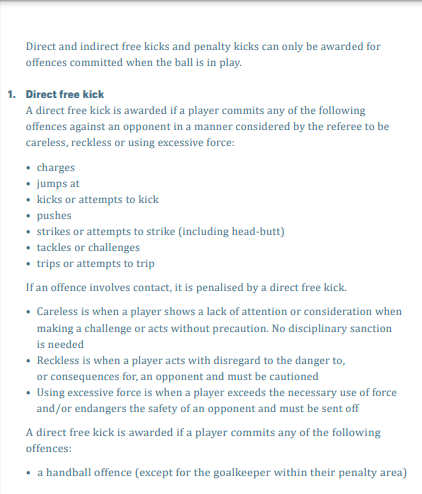
I’ll say it here and leave the subject alone. Center referee Jervis Atagana’s decision making during this match was very poor. He allowed conditions to progress to the point where players were facing injuries. In a day and age where head injuries are being monitored closely, Atagana showed no regard for Boyce’s health and safety in that situation. His inability to control the match was a disservice to both clubs, the fans, and the sport. I hope he is put under review and re-educated on the laws of the game. If not, his superiors are willfully accepting the risk of bodily harm on players in future matches in which he is assigned to officiate.
It wasn’t until the 82nd minute when Union Omaha correctly received a penalty kick. FC Tucson had just launched a goal kick toward the half line and Conor Doyle collected the 50/50 ball. As he looked downfield, he saw the slimmest of passing lanes leading Evan Conway into the penalty area. Conway took his defender 1-on-1 and was tripped inside of the box. This was an easy call for the center referee to make.
Damiá Viader was the man to take the penalty kick, but before a little more gamesmanship from FC Tucson. As the other players line up around the 18-yard box, they cannot enter the arc at the top of the box, as well. Tucson players took advantage of the moment, treading just inside of the restricted areas. The center referee had to call attention to their placement, take time away from the penalty kick to explain this to the players, and leave Viader standing in position for those extra seconds. Basically, it’s soccer’s version of “icing the kicker.”
When Viader took the shot, he aimed for the right side of the goal. FC Tucson goalkeeper was out of reach, but the ball hit the right post, glanced off of the goalie’s leg, and went out of bounds for a Union Omaha corner kick.
The only remaining chance on goal for Union Omaha came in the 90’+3 (three minutes into stoppage time). As FC Tucson tried to clear the ball, it bounced straight to Conor Doyle’s position and he ripped it off the bounce, but the ball went wide. For half of a heartbeat, there was a glimmer of hope watching that ball on route to the net. The Owls spent the remainder of stoppage time scrambling to produce another chance, but it never came to fruition.
Union Omaha should have had three penalty kicks and were robbed of a breakaway, but they had several other chances to take care of business. It’s perfectly reasonable to be angry with the referees, but the Owls did have their chances to determine their own destiny. Putting the entire loss on the backs of the referees is more of an emotional response than a logical one. This Saturday, Union Omaha travels to South Georgia Tormenta before having five straight home matches. There are plenty of points to earn and excitement to watch, so stay tuned to Union Omaha and USL League One action. The playoffs are just around the corner.
I don’t know if you saw the Data Dump earlier this week, but Ben, and awesome sidekick Tim, put out a good article with plenty of statistics to read. There was also a new episode of the podcast released today. We here at Who Gives A Hoot Media are working hard to make sure you’re getting the best information and plenty of entertainment along the way, as well. Whether it’s the podcast, the articles, or the social media posts, we’ve got you covered for all things Union Omaha, with a dash of USL League One information here and there. Thank you for your continued loyalty to us. Do you have a question that you’d like us to answer? Feel free to send it our way and we’ll do our best to keep you informed. Do you have any ideas for articles or features in the podcast? Let us know those, as well. We’re here for you, so if it’s something we can manage, we’ll make it work.
 Who Gives A Hoot?