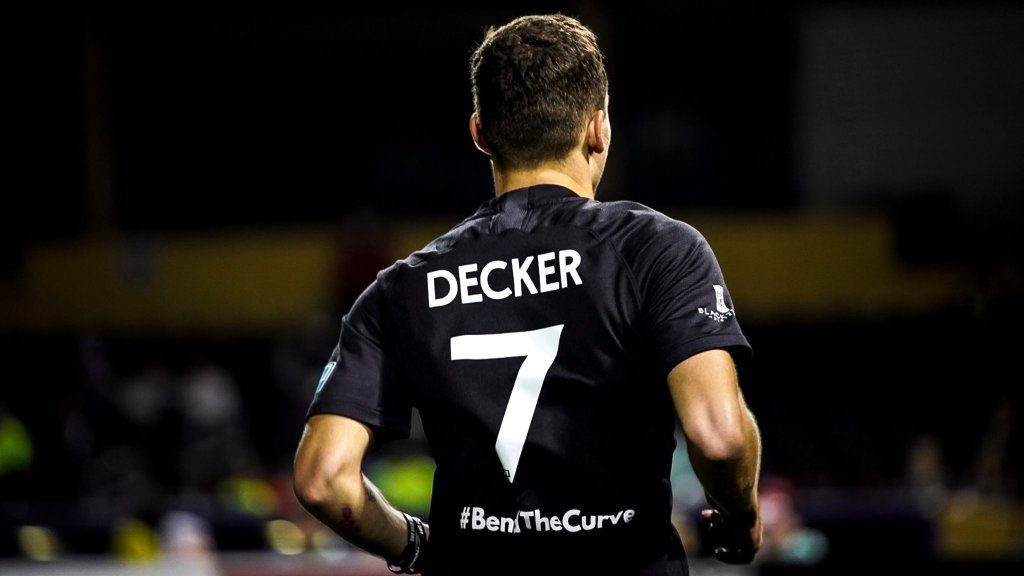
Hello and welcome to the only article you need to read if you have a vote for MVP. As the founder of the #EVD4MVP movement that is sweeping the nation (Buho Nation), I want to bring the case full circle and show why Ethan Vanacore-Decker is the only choice for the 2020 USL League One MVP award.
I. MVP Criteria
An MVP award is given to the player who was most valuable for the entire season in the whole league. Usually this is an award given to the best player on the best team, but that is not always the case. For the purposes of this article, I am trying to make the case that the most valuable player in the league is the one who contributed more than any other player did in giving his team a chance to win a championship.
2020 was the second season of USL League One, so we really only have a single data point from last year to create a model from. The 2019 USL League One MVP was Arturo Rodriguez of North Texas SC. The simplest case for his MVP award is this: He led the league in assists with 10, had 7 regular season goals (top 10), led the league with 78 chances created, and his team finished top of the table. Overall, he was involved in 32% of his team’s goals.
From this I think we can establish some criteria for our list of candidates: top 3 in assists, top 10 for goals, top 5 in chances created, and a top 2 finish in the league for their team. And to be considered, you need to meet 3 of the 4 criteria.
II. 2020 Candidates
Using our criteria above let’s see who our candidates are:
- Alex Morrell: 5 goals (6th), 6 assists (2nd), 34 chances created (3rd), 1st place
- Ethan Vanacore-Decker: 3 goals (16th), 6 assists (1st), 28 chances created (5th), 2nd place.
Seriously that’s it. Even if you expand the net out a little bit you still don’t really pick up any candidates.
That said, you know the league will offer us five candidates so here are the other three I think they will select: Michael Vang: 4 goals (9th), 2 assists (16th), 26 chances created (6th), 7th place; Emiliano Terzaghi: 10 goals (1st), 0 assists (last), fewer than 10 chances created, 4th place; Greg Hurst: 8 goals (2nd), 2 assists (16th), 19 chances created (17th), 5th place. If you are looking for a dark horse candidate I think Arturo Rodriguez could sneak in there again. You can check their stats below:
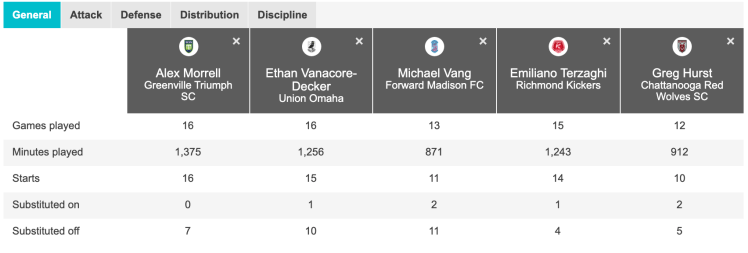
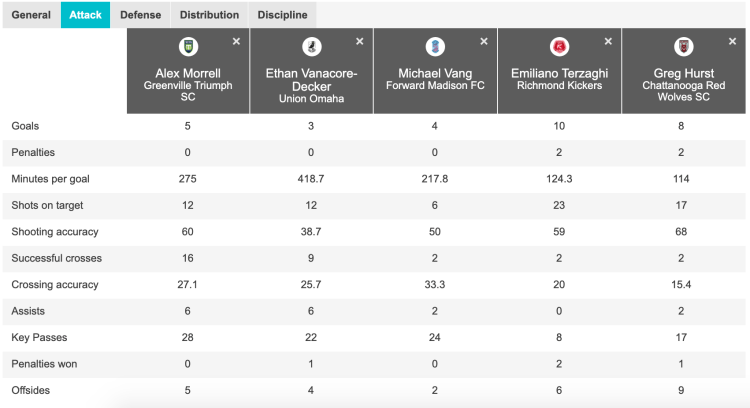
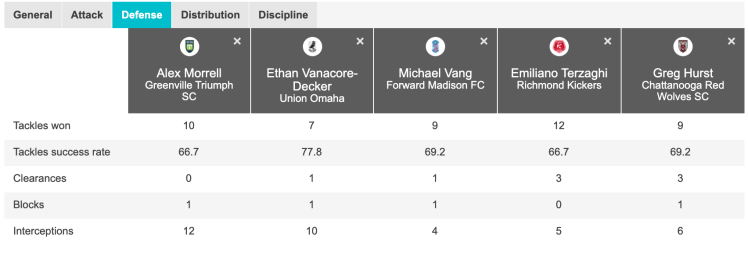
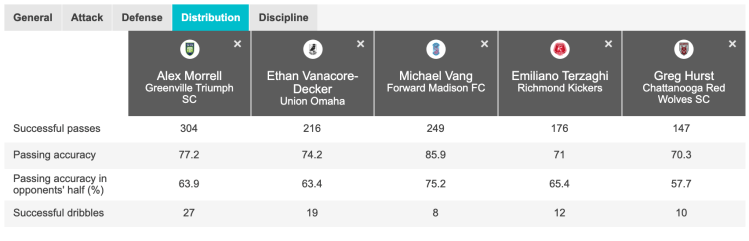
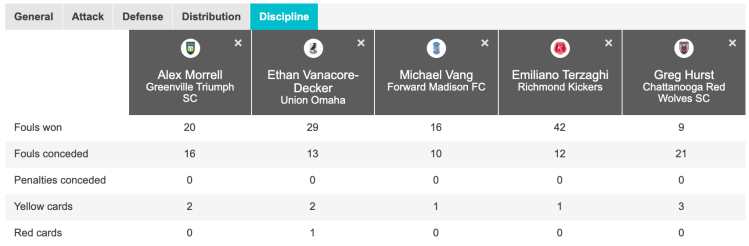
All of these candidates have flaws in statistical categories, their league finish, or both. Kudos on a great season to all of them, but let’s eliminate them and move on.
III. Chances Created
Opta defines Chances Created as, “Assists plus Key Passes (the final pass or pass-cum-shot leading to the recipient of the ball having an attempt at goal without scoring).” Although the League has a leaderboard for this as one of their four major offensive statistical categories, I think it is the category we should put the least weight in.
I’m not saying it doesn’t matter (it does) but it shouldn’t matter TOO much. When the final calculus is done, if you’re creating a lot of chances and are not appearing on the leaderboard for assists like Charlie Dennis or Marco Micaletto, then your teammates are letting you down by not finishing the chances you are creating for them and your team is probably not succeeding.
So while Alex may have created MORE chances than EVD, EVD’s chances paid off more often. Could we say that EVD’s chances created were better than Alex’s because they more frequently led to goals? Sure, but any MVP argument that is being decided by chances created is probably flawed. So, this is the last time I’ll mention it.
IV. Assists
These are baked into chances created, and each player had 6. EVD won this title because he played fewer minutes than Alex on the season. Obviously, being the assist leader is important, and the previous MVP was the assists leader as well. Every assist means a goal created, and you can’t win without scoring goals (ask Forward how things went at Hart Park this season).
The margin here is pretty small, but not as small as the league made it seem. EVD played 119 fewer minutes than Alex, which is more than a full game. Additionally, EVD won a penalty that was converted by another player, a small detail we MUST take into account. I will continue to talk about that as its own category, but I view it as an assist.
V. Goals
Even though the MVP award last season went to the best creator, goals are important. However, Alex Morrell’s 2 goals in a meaningless game against the worst team in the league should not fool voters into thinking he was somehow more valuable on the season.
Greenville clinched their spot in the final on Oct 3rd against Orlando City B, and they clinched home field advantage before their game on Oct 18th against Union Omaha. Greenville’s final regular season match was away to Orlando City B. Win, lose, or draw the Triumph was playing in the Final at home. Alex Morrell scored 2 goals in that game, goals that did nothing to shape the season Greenville had. Wikipedia defines garbage time as “the period toward the end of a timed sports competition that has become a blowout when the outcome of the game has already been decided.”
The Triumph’s game against OCB was the definition of garbage time, and Alex’s goals were garbage time goals. The margins between these two players are thin, but this should not be the deciding factor.
VI. Home-Away Splits
League One has some terrible travel that tends to affect teams when they are away and give a strong home field advantage. So a potential way to tell these two apart might be their home and away splits: who performed better in a more difficult environment.
Home:
Alex: 1 goal, 3 assists.
EVD: 0 goals, 3 assists, 1 penalty won.
Away:
Alex: 4 goals (2 garbage time), 3 assists.
EVD: 3 goals, 3 assists.
The unbalanced schedule had us playing at Hart Park while Greenville played at Osceola County Stadium. Alex Morrell used that to his favor by scoring 2 goals there, but overall, both players were very impressive away from home.
VII. Goal participation
Another way to determine how valuable a given player is to the team is goal participation: what percentage of overall goals scored did the player score or create. Greenville had 24 goals on the year, Alex Morrell participated in 11 of them (5 goals, 6 assists), or 45.8%. If we factor out “garbage time” games against UO and OCB, Alex participated in 9 of 19 goals or 47.4%. Union Omaha had 20 goals on the year, EVD participated in 10 of them (3 goals, 6 assists, 1 penalty won), that is 50%. Clear advantage to EVD, who was involved in more goals by percentage no matter how you slice it.
VIII. Points earned
While goals are important to each individual game, the results from each game matter in the table. In a draw, every goal scored in a game matters, while in a win ALMOST every goal matters. I took goals, assists, and penalties won metrics and determined how many points the team earned in games where a player contributed to the scoring. The total points earned and percentage of total points earned will help us understand how valuable each player was to their team’s successful season.
Alex Morrell (including garbage time): 7 games, 21 points, 60% of points GVL earned on the season.
Alex Morrell (excluding garbage time): 6 games, 18 points, 51.4% of points earned.
Ethan Vanacore-Decker: 8 games, 20 points, 69% of points earned
The goals created by EVD created more of Union Omaha’s points on the season than Alex Morrell did by percentage of total. And if you exclude those garbage time games, total points as well.
IX. Game Winners
There is nothing more spectacular than a dramatic game winning goal. For the purposes of this exercise, a game winner is defined as a goal that is the difference between winning and drawing. In a one-goal game that is pretty obvious. In a multi-goal game it is the first goal scored.
Alex Morrell: 2 goals, 4 assists
Ethan Vanacore-Decker: 2 goals, 3 assists
Alex has the advantage in this category, but the slimmest of margins: just one assist. However, if you look at those wins as a percentage of the total wins the team earned, once again EVD has the edge. EVD provided more game winners as a percentage of wins than Alex Morrell did.
Alex Morrell: 6 game winners on 11 wins total. (54.5%)
EVD: 5 game winners on 8 wins total. (62.5%)
X. Rescued Points
All of Alex’s goals and assists that factor into the game winner category took the margin from 0-0 to a winning position or became game winners after Greenville gave up a late goal.
On the other hand, Ethan had multiple games where his game winners came after the opponent had drawn level. The stakes are raised in a situation like this, and the drama is increased. Put another way, Ethan “rescued” points for his team on multiple occasions, where Alex did not rescue any points all season. Here is the list of EVD’s rescued points.
North Texas (Away): Assist to draw level after going down 1-0.
North Texas (Away): Goal to draw level after going down 2-1.
FC Tucson (Home): Assist to win the game after giving up an equalizer.
Fort Lauderdale (Away): Goal to win the game from 2-2, after UO gave up 2 equalizers.
Greenville (Away): Assist to win the game from 1-1, after UO gave up an equalizer.
To summarize:
Alex Morrell: 0 points rescued.
EVD: 10 points rescued.
XI. Contributions that didn’t affect the outcome: aka fluff
Earlier we introduced the concept of “garbage time” for the League One season, but what about individual games? In a league with the primary tie-break as wins, the difference between a 1-0 win and 3-0 win is very little. So let’s look and see if either player had production that was the cherry on a sundae instead of the ice cream.
Alex Morrell:
07/19: A to Ft Lauderdale: Assist (2-0 win)
10/03: H to Orlando City B: Goal (2-0 win)
10/24: A to Orlando City B: 2 Goals (4-1 win)
Ethan Vanacore-Decker:
10/03: H to Tormenta: Assist (3-0 win)
So let’s adjust the stats to see what they look like if you strip away the fluff.
Alex Morrell: 2 goals, 5 assists.
Ethan Vanacore-Decker: 3 goals, 5 assists, 1 penalty won.
Said another way, if Alex Morrell had 3 fewer goals and 1 fewer assist, Greenville Triumph has the same season. If Ethan had 3 fewer goals and 1 fewer assist, Union Omaha doesn’t finish second. When you are trying to determine who is most valuable, meaningful contributions to results is vital and EVD did a better job of it.
XII. Conclusion
So let’s review. We know that in the past MVPs have led the league in assists, scored goals, and been on very successful teams. Both players meet that criteria. We have two players extremely close together statistically. Alex has a slight edge in goals, Ethan has a slight edge in assists. Greenville finished higher on points, but both teams had the same chance for a championship. To separate this we had to dive into the details.
Alex’s two “garbage time” goals against OCB give him the lead on paper, but when we dive in, we see EVD is the stronger candidate. EVD has a higher goal participation percentage: 50% to 45.8%. EVD participated in a higher percentage of the team’s points earned on the season: 69% to 60%. Alex created 3 more points via game winning goals or assists than EVD, but EVD’s game winning contributions account for a higher percentage of his team’s wins. EVD rescued 10 points on the season, while Alex rescued none. Finally, EVD had less fluff with 3 goals, 5 assists, and 1 penalty won contributing directly to results for his team, while Alex only had 2 goals and 5 assists that contributed directly to results.
The point of the most valuable player award is to recognize the contributions of the player who was most VALUABLE to his team on the season. It is clear from the statistics laid out above, that despite the similarities on the surface between the two players, EVD’s contributions simply were more VALUABLE to Union Omaha than Alex Morrell’s were to Greenville.
In closing, if in assists he leads the league, vote EVD for MVP; if the goals win, you gotta vote for him. #EVD4MVP

 Who Gives A Hoot?
One thought on “Data Dump: #EVD4MVP Special Edition”